
A primer on market access
Why drugs miss commercial forecasts, and what earlier alignment between clinical and market access teams could fix

Welcome back to Kiin Bio Weekly.
Most of what we cover in the newsletter is preclinical and clinical: how drugs get discovered, how they get tested, whether the science holds up. We started wondering what happens after approval. Do approved drugs actually sell well? If not, why, and what would fix it?
One-third of launches miss expectations and this pattern hasn’t moved in a decade. Deloitte’s 2012-2021 US launch cohort: 34% missed, 66% met or beat. Clinical approval fixes the science; it does not fix reimbursement. Whether payers will fund a drug, at what price, for which patients, and how quickly involves different decision-makers with different evidence requirements. 57% of launch failures trace to limited market access, 47% to inadequate understanding of market needs, 41% to poor differentiation (Deloitte, 2022).
The endpoint problem is central. A drug can be approvable but commercially weak if the trial proves an endpoint (i.e. a “measurable outcome”) that regulators accept but payers, doctors, or patients do not value enough to justify price, switching, or broad coverage.
The fix is about who’s in the room, and when. Drug discovery is a long value chain. The people who understand reimbursement, access, and real-world uptake need to influence decisions at the start: target selection, trial design, evidence planning. The best programmes run market access due diligence before they start, not after Phase 3 locks.
Do you fancy getting free access to a platform that helps speed up your scientific research?
We're running a programme that gives academic and nonprofit labs a full year of access to our platform where you can run lit reviews, target discovery, and bioinformatics in one place, among many other things. We also throw in direct support from our science team.

For this piece, I spoke with Gerardo Martinez, Senior Director of Global Market Access at CSL, and Maria Garcia, who leads the medical committee on independent reimbursement risk assessments at MARA Rating. Their insight runs throughout.

How market access works in practice
Once a drug is approved by a regulator (FDA in the US, EMA in Europe), it still needs to clear a second gate before patients can actually get it. That gate is Health Technology Assessment (HTA).
In England, NICE (National Institute for Health and Care Excellence) evaluates whether a drug offers enough clinical benefit relative to its cost to justify NHS funding. In Germany, G-BA (Federal Joint Committee) runs a benefit assessment that determines pricing tiers. In France, HAS (Haute Autorité de Santé) scores therapeutic improvement on a five-point scale that directly sets the reimbursement level. In the US, the system is more fragmented: CMS (Centers for Medicare & Medicaid Services) makes coverage decisions for government insurance, while private payers and pharmacy benefit managers each set their own formulary rules.
These bodies ask different questions from regulators. Regulators ask: is this drug safe and effective? HTA (Health Technology Assessment) bodies ask: is it better than what we already pay for, by enough to justify the price difference? That gap is where most of the launch failures in this piece originate.
How drugs are valued (and where the model breaks)
Before getting into how launches fail, it is helpful to understand how drugs are valued before they enter the market.
Drug valuation starts as a risk-adjusted net present value (rNPV) model. You estimate future cash flows based on patient population, discount them by the probability of the drug making it through each development stage, and subtract remaining costs. Each stage transition (preclinical to Phase 1, Phase 1 to 2, and so on) gets its own probability of success, so the model penalises early-stage assets more heavily. It forces uncertainty into the maths. The problem is that the model looks quantitative while hiding qualitative judgments about payer behaviour, patient burden, and whether anyone will actually switch from the existing standard of care.
The assumptions that matter most: how many patients will be eligible and diagnosed, what price payers will accept, how quickly physicians will switch, how long patients will stay on therapy, and whether a competitor will reset the value bar before you reach peak sales. A one-point shift in any of those can dominate the model. rNPV is useful for comparing assets in a portfolio. It is dangerous when people treat its output as a prediction rather than a structured guess.
Estimates of what it costs to develop and approve a single drug range from ~$1 billion to $2.6 billion depending on methodology and how you account for failures. When this much capital is at stake, getting the commercial assumptions wrong early (as is the case for 34% of the drugs that underperform in sales) means the loss compounds for years.
When the trial answers the wrong question
Regulatory endpoints and payer endpoints overlap, but they are not the same thing. The FDA will approve a drug based on a surrogate biomarker if the evidence is strong enough. Payers, HTA bodies, and physicians often need something more: proof that the drug changes outcomes patients actually care about, measured against a comparator that reflects real-world practice rather than placebo.
This is exactly what Gerardo described from the payer side of the table. “Payers are not only asking, ‘Does it work?’” he told me. “They are asking, ‘Does it work better than what we already fund? In which patients? How meaningful is the benefit? Is it worth the opportunity cost?’” The strongest access cases don’t avoid uncertainty. They anticipate it, make it visible early, and address it directly.
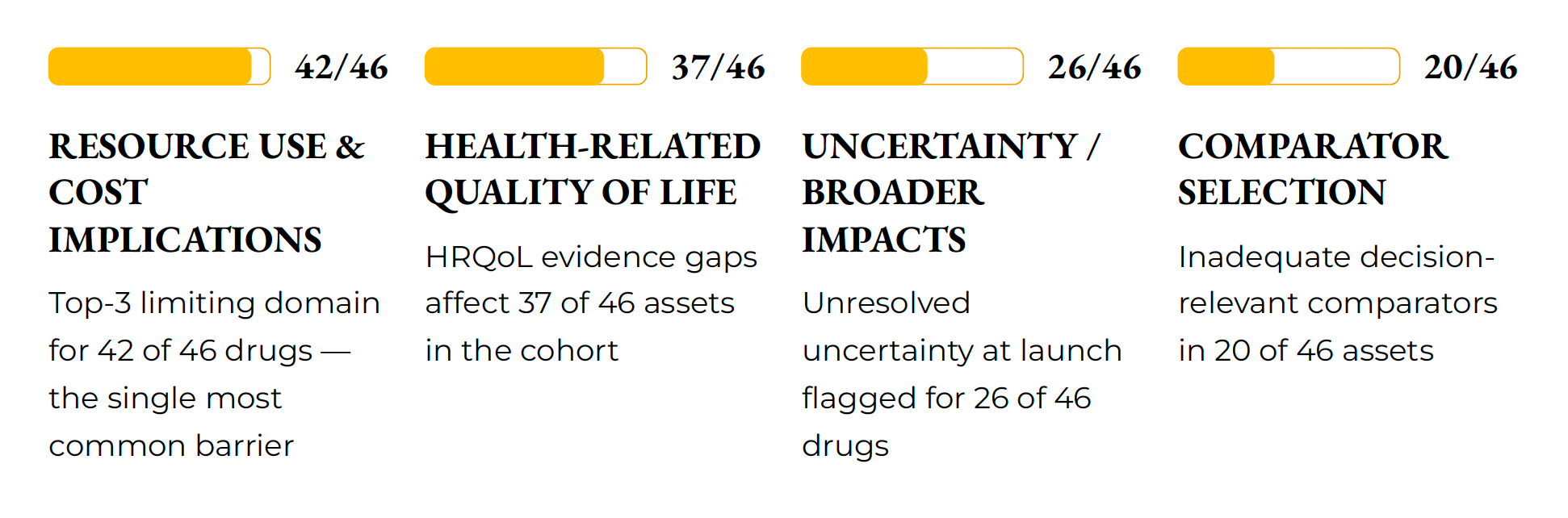
MARA’s analysis of that 2025 cohort identified exactly where the evidence falls short. The most common gaps were not in core clinical efficacy. They were in resource use and cost implications (flagged in 42 of 46 drugs), health-related quality of life evidence (37 of 46), unresolved uncertainty at launch (26 of 46), and comparator selection (20 of 46). These are the domains payers use to judge comparative value, implementation risk, and affordability. None of them are guaranteed by FDA approval.
The cleanest example of what happens when they don’t is Aduhelm (aducanumab), a drug for Alzheimer’s disease from Biogen. FDA granted accelerated approval based on amyloid plaque reduction, a biomarker CMS (Centers for Medicare & Medicaid Services) responded by limiting Medicare coverage to patients enrolled in clinical trials. Physicians were sceptical, uptake was negligible, and Biogen discontinued the drug in 2024 after investing several billion dollars in development. The biology worked, the regulatory bar was met, and the commercial outcome was still a catastrophe.
The useful contrast is Leqembi (lecanemab), in the same disease, same drug class. The difference: the confirmatory trial measured clinical decline on CDR-SB, a cognition and function endpoint. FDA converted it to traditional approval. CMS broadened coverage. The Alzheimer’s market did not reject anti-amyloid drugs categorically. It needed evidence that connected the mechanism to something patients and families could observe.
The same pattern shows up elsewhere. Avastin, Makena, Iressa: in each case, the endpoint problem was visible long before the commercial failure arrived.
There is also the rarer, more catastrophic version: post-market safety. Phase 3 trials are typically too small and too short to catch every rare or delayed adverse event. Once a drug reaches real-world populations, broader exposure can turn “manageable safety uncertainty” into boxed warnings or full market withdrawal. A 2025 JAMA Internal Medicine analysis of 560 drugs approved 2001-2019 found 23.2% experienced a post-market safety action, meaning that 13 drugs not only caused patients issues but also caused financial loss to pharma companies, e.g. through slower prescriptions or adoption.

When it works: the GLP-1 story
GLP-1 drugs are the opposite case. Wegovy and Zepbound did not rely on an abstract biomarker. The primary endpoint was body weight reduction, something patients can see, physicians can track, and media can amplify. The effect size was large enough to reset expectations for the entire obesity category. Then the SELECT trial added cardiovascular outcome data, moving the class from “weight loss drug” toward “cardiovascular risk reduction in patients with obesity.”
The trials also got the population right. The label covers adults with obesity (BMI 30+) or overweight (BMI 27+) with at least one weight-related condition. That is enormous, well-defined enough for payers to recognise as medically necessary, and broad enough to generate demand at scale. WHO estimates 2.5 billion adults are overweight globally and 890 million have obesity.
The result: Ozempic and Mounjaro alone generated $71 billion in 2025 revenue. For context, that is roughly 2.5x the combined revenue of OpenAI and Anthropic in the same year. Only ~2% of the 800 million eligible patients currently have access. Worth noting: most GLP-1 prescriptions are paid out-of-pocket or through private insurance rather than through HTA-assessed public reimbursement, so the market access dynamics here are different from most drug classes. Demand so massively exceeded expectations that supply became the bottleneck, not coverage.
What made it work: the endpoint was clinically measurable, commercially legible, and expandable into harder outcomes. Start with something everyone understands, then add evidence that justifies broader coverage. Few drug classes have executed that sequence this well.
Who gets it right (and why)
Deloitte’s data shows consistent patterns in what predicts launch success. Drugs granted priority review (meaning the FDA considered them a significant improvement over existing options) met or beat forecasts 74% of the time, versus 47% for standard review. Specialty drugs (typically higher-cost treatments administered under physician supervision or requiring special handling) outperformed at 72% versus 48%. Orphan drugs (for rare diseases affecting fewer than 200,000 patients) hit 73% versus 57%. First-in-class drugs and products reimbursed under the medical benefit (paid directly by insurers rather than through pharmacy channels) also outperform.
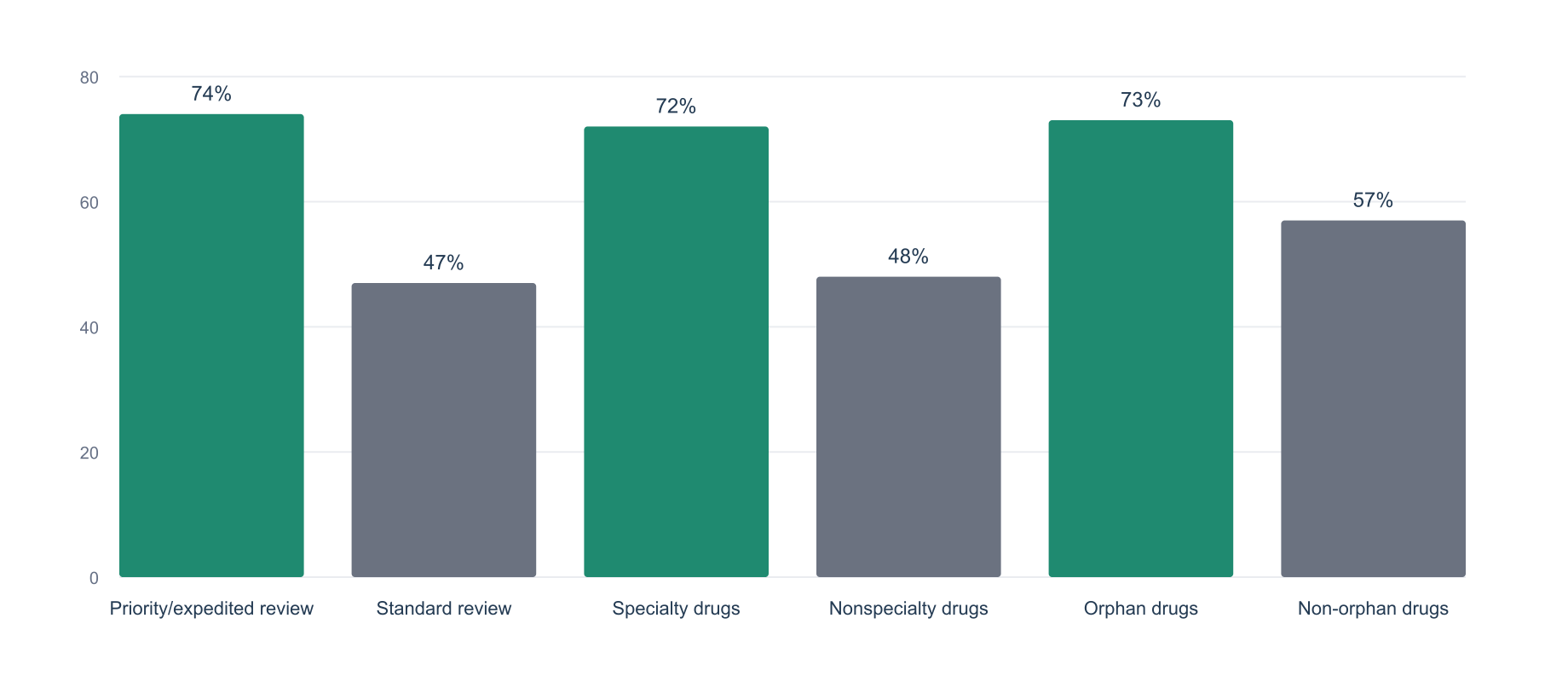
This does not mean “rare and expensive always wins.” It means launches go better when the unmet need is visible, the patient population is defined, the specialist community is concentrated, and the product gives payers a coherent reason to change behaviour. The more diffuse the population and the more crowded the market, the harder the launch. General medicine is especially brutal: 58% of general medicine launches missed expectations in the 2012-2021 cohort.
Maria Garcia, whose team at MARA Rating assesses assets calibrated to real-world HTA decisions, described the pattern she sees at scale: “Some companies repeatedly produce evidence packages with strong reimbursement readiness. Others show recurring gaps regardless of asset or indication. That’s not a coincidence. It’s organisational discipline, embedded at programme design level.” That distinction is financially material. It shows up in launch delays, managed entry terms, and access rates that never reach modelled uptake.
What the disciplined ones do differently is structurally simple, she said: “They integrate market access into trial design, not after it. They run HTA scientific advice before Phase 3 lock. They don’t confuse regulatory approval with reimbursement readiness. Those are two different standards, assessed by two different bodies, under two different evidentiary logics.”
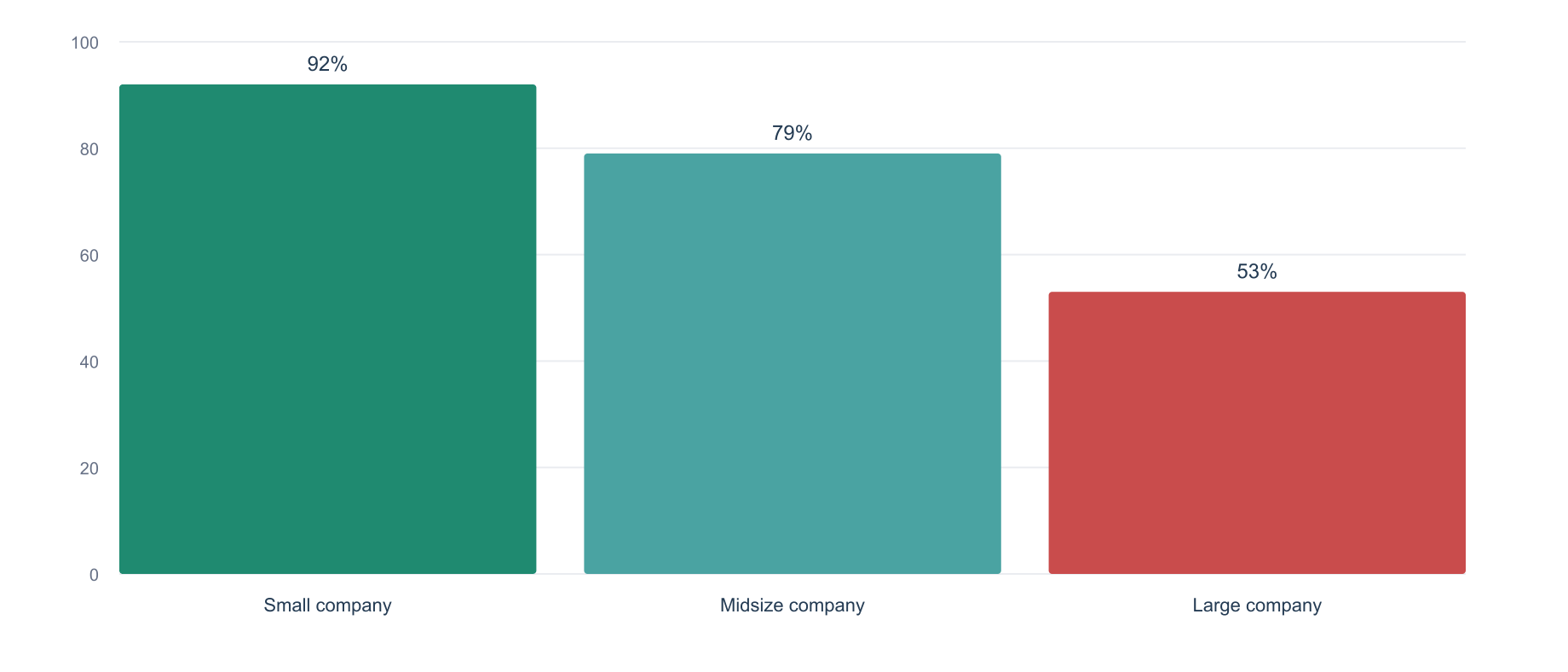
Company size matters too, in a counterintuitive direction. In orphan drug launches, 92% of small company launches and 79% of midsize launches met or beat expectations, compared to 53% for large pharma. Smaller companies have faster and easier communication thanks to their size and have normally built the whole organisation around one disease area and one patient journey. Large companies have more muscle, but also more silos and more inherited constraints from acquired assets where the trial design was already locked.
Modality choice at the preclinical stage also constrains access strategy years later. The commercial model for an oral small molecule in general medicine is fundamentally different from a cell therapy in rare disease, and the evidence package needs to reflect that from the start. I asked Gerardo whether rare disease is genuinely easier because there are often no existing treatments. His answer was blunt: “Rare disease is not easier. It is different. The absence of treatment can help the narrative. It can also make the evidence problem harder.”
Maria went deeper on the friction points that catch teams off guard. In rare diseases, HTA bodies are built to answer “compared to what?” and that anchor often doesn’t exist. In gene therapies, durability uncertainty is the real wall: you’re asking a payer to fund twenty years of projected benefit on two years of follow-up. Then there are budget impact optics. “A therapy treating three hundred patients can price at seven figures and still cost the system less than a common chronic disease,” she pointed out. “The optics dominate the economics, and companies consistently underestimate it.”
How do we fix this?
A growing number of companies are building tools to close the gap between clinical development and market access.
MARA Rating takes a different approach from most: independent, standardised reimbursement risk scores. They rate assets from A++ to C across domains calibrated to historical HTA outcomes, giving portfolio teams an external benchmark for access risk the same way credit ratings benchmark financial risk. Clinical, regulatory, and manufacturing risks are routinely benchmarked in portfolio governance. Reimbursement risk often is not.
On the analytics side, Datavant builds real-world evidence platforms that let teams model whether a single study design can serve both regulatory and HTA purposes. Panalgo (now part of Norstella) offers self-service RWE analytics so teams can rapidly test whether their chosen endpoint will matter to payers during trial design rather than after it. IQVIA‘s Launch Excellence suite specifically targets the forecast-miss problem with payer landscape intelligence and formulary tracking at scale.
On the strategy and intelligence side, Lumanity models different trial design scenarios against likely HTA outcomes across markets, explicitly positioning around the clinical-to-commercial alignment problem. Certara‘s Evidence & Access division links pharmacometrics directly to HTA submission requirements, so clinical pharmacology decisions get pressure-tested against payer needs early. Atheneum runs an AI-matched expert network connecting pharma teams to payer and HTA advisors early in development. Sometimes the fix is not better analytics; it is getting clinical teams in front of the right people before Phase 3 locks.
The alignment problem
Market access teams typically get involved too late. In most pharma companies, market access sits under commercial, grouped with sales rather than at the executive table. So when clinical teams are locking Phase 2/3 designs, market access isn’t in the room. Maria Garcia was direct about this: “Commercial is not the same as market access. It’s a very different understanding of the market.” Commercial teams handle sales strategy and conference presence. Market access determines whether anyone can actually pay for what you’re promoting. Because they share an org chart, they get conflated, and market access professionals end up without authority to redirect development even when the reimbursement outlook is clearly poor.
Gerardo framed this as the central misconception: “The biggest misconception is that market access starts after the product is developed. It is not just a launch function. It is a strategic bridge between innovation and real-world adoption.” The companies that get this right expose asset teams to market access constraints while there is still time to change the endpoint, comparator, population, or evidence plan. The ones that get it wrong throw a finished clinical package over the wall and wonder why the launch underperforms
The problem goes deeper than timing. Before starting any programme, teams should be running market access due diligence to assess whether a programme is even worth progressing. What matters is the speed of the feedback loop between what the science can deliver and what the market will accept.
You cannot change organisational structure overnight. What you can do is build systems that translate and pass information between teams, surfacing what matters at each stage. AI is well-suited to this. Gerardo was measured: “AI can help us move faster. It can support evidence mapping, landscape scanning, analog analysis, payer objection tracking. It can help us see patterns earlier and pressure-test assumptions with more speed.” The hype is the idea that AI replaces market access judgment. It does not. “Market access is interpretation, prioritisation, and judgment under uncertainty. AI gets us to a sharper first draft. The real value still comes from human judgment.”
The strongest use case is giving preclinical and clinical teams a live view of market access constraints. Which endpoints convinced payers in which countries? What does the standard of care look like by market, by patient subgroup? These questions are answerable from HTA decisions, trial registries, claims data, and payer policies, but nobody has the time to synthesise them manually for every asset in a portfolio. That is the gap a platform can fill: not replacing judgment, but making sure the right information reaches the right team before the design is locked.
Data sources: Deloitte launch cohort analyses (2020, 2023, market access framework), BIO/Informa/QLS clinical success rates 2011-2020, Wouters et al. JAMA 2020, MARA Rating 2025 NME Analysis. FDA regulatory documents, WHO/OECD pharmaceutical pricing policy publications. Full source notes available on request.
💬 Want to be featured in Kiin Bio Weekly?
Each issue we speak directly with researchers, scientists, and builders working at the frontier of AI in life sciences. If you're working on something in this space and think it would resonate with our community, I'd love to hear from you. Fill out this form or reach out to me directly.
Found this useful? Forward it to a colleague or friend you think would be interested, it's the best way to help the newsletter grow.
Subscribe now to stay at the forefront of AI in Life Science. Every week: primers, deep dives, and direct conversations with the people building the field.
Connect With Us
Have questions on this or suggestions for our next deep dive? We’d love to hear from you!
📧 Email Us | 📲 Follow on LinkedIn | 🌐 Visit Our Website