
A Primer on the Comp Bio Career Landscape
Salaries, skills, and hiring data from 2,000+ UK listings and a specialist recruiter

Welcome back to Kiin Bio Weekly.
Who this piece is for: Computational biology professionals and hiring managers navigating the UK market in 2026.
What this covers: Where the roles are, what they pay, and what actually gets people hired, based on recruiter data and 750+ live listings.
The takeaway: The market rewards specialists who can ship, not generalists who can apply. Infrastructure roles are where demand is highest, entry-level is brutally oversaturated, and your visibility matters more than your credentials.
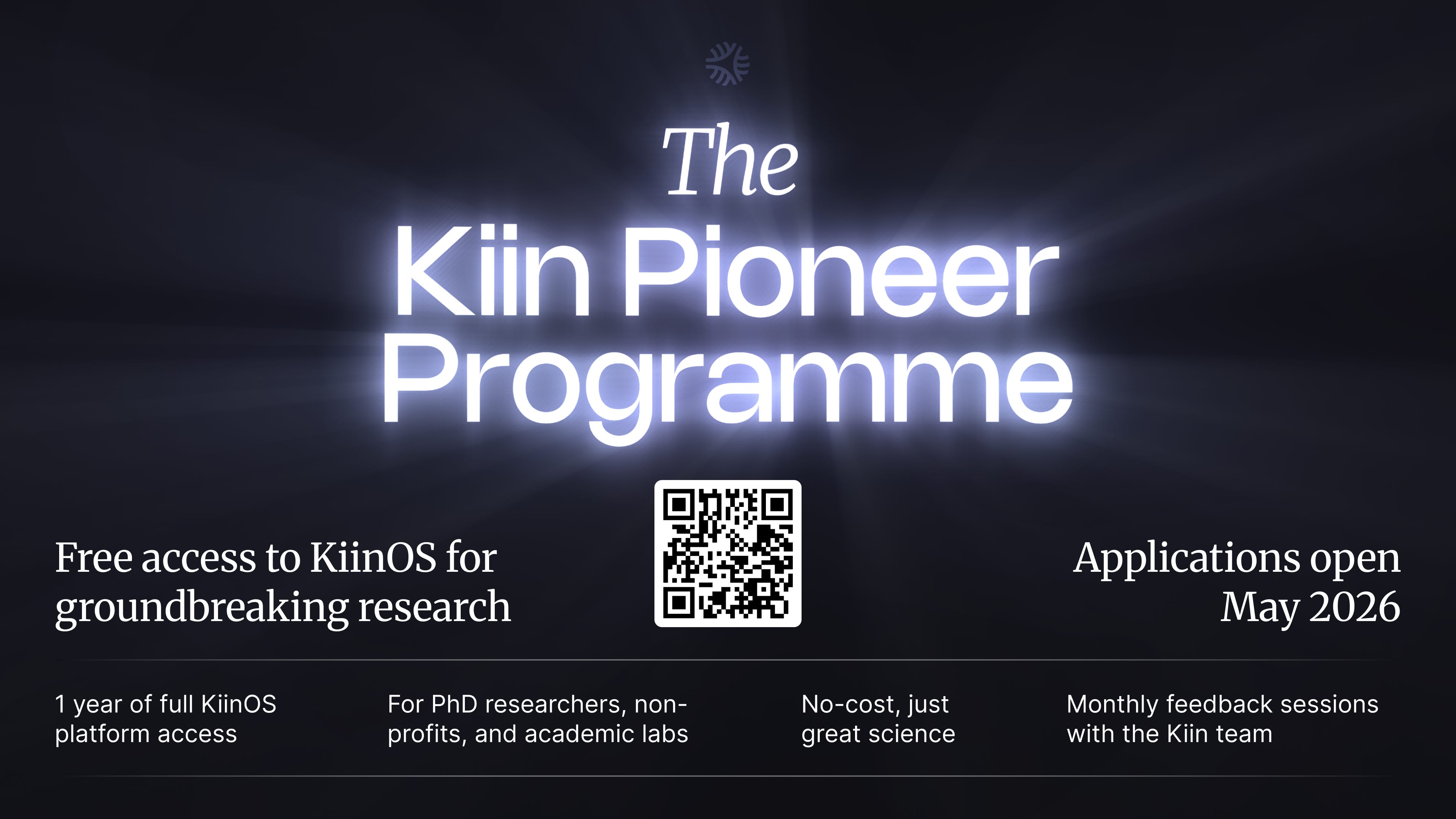
Freebie alert: We know how hard science is. That’s why we built the Pioneer Programme.
We’re selecting academic and nonprofit teams to get one year of free access to our drug discovery platform, with support from our science team. If you spend more time pulling together findings from different sources than actually acting on them, it’s worth applying.
No cost, no data transfer, all IP stays with your institution. Applications close August, cohort starts September.
The computational biology job market in 2026 has split in two. We wanted to dive deeper to understand why, and try to think about what might happen next.
Traditional pharma has been making considerable cuts for over a year. Bayer alone cut roughly 14,500 roles between 2022 and 2026, with the steepest reductions in 2024 and 2025. BMS and Teva followed with thousands more. AI-native biotech, meanwhile, is hiring faster than the talent pool can seem to keep up. As a quick example, Isomorphic Labs has 21 open ML drug discovery roles in London alone.
We looked into the market dynamics, skill levels, salary benchmarks, and hiring patterns across 2,000+ UK listings on LinkedIn, and spoke to Joe Phillips, Principal Consultant BioAI at Cubiq Recruitment, a specialist recruiter in bio-AI and computational life sciences. Everything we found is in here: where the roles are, what they pay, who’s getting hired, and what we think happens next.

“There’s an enormous amount of strong academic talent coming through, but the number of genuinely junior opportunities is tiny compared to demand. The candidates who stand out usually have something beyond their degree alone to show.”
📊 Where the roles are
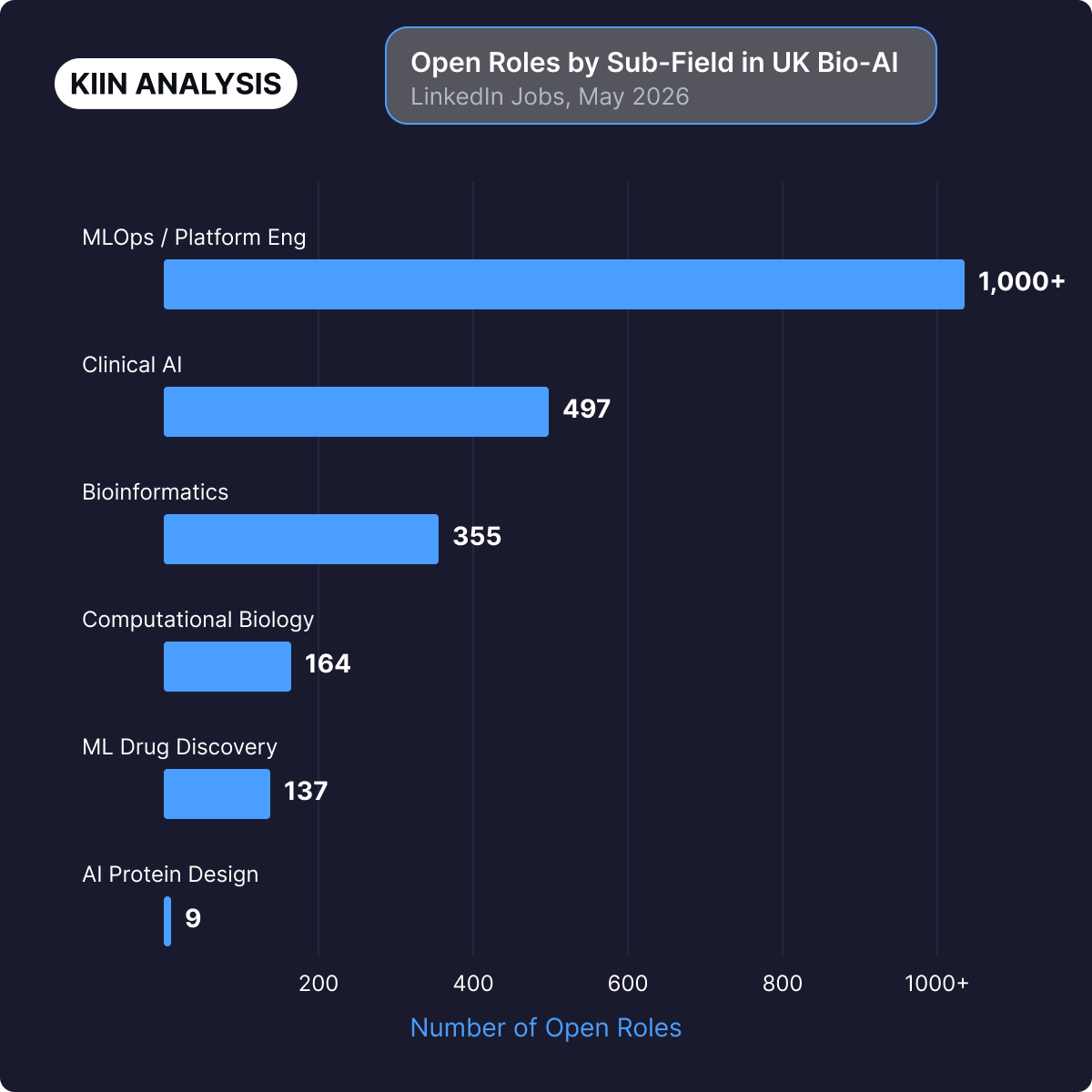
Across the UK, there are currently 2,000+ open positions in computational biology, bioinformatics, AI drug discovery, and adjacent infrastructure roles (source: LinkedIn Jobs, May 2026). These span big pharma, AI-native biotech startups, NHS trusts, CROs, and platform companies selling into life sciences.
MLOps and platform engineering (1,000+ roles): The biggest category by far, and probably the most surprising if you haven’t been watching the infrastructure side of biotech. Why so many? McKinsey’s 2025 State of AI report found that 88% of companies now use AI in at least one business function (up from 78% the year before), but roughly two-thirds are still stuck in pilot mode. Companies built research teams over the last few years, proved that their models work, and now need people who can operationalise them at scale. Joe says this is the biggest shift he’s seen: “A lot of this work was previously absorbed by ML Engineers. Now the cost and complexity around compute, GPU utilisation, and inference has become significant enough that firms are hiring specialists.”
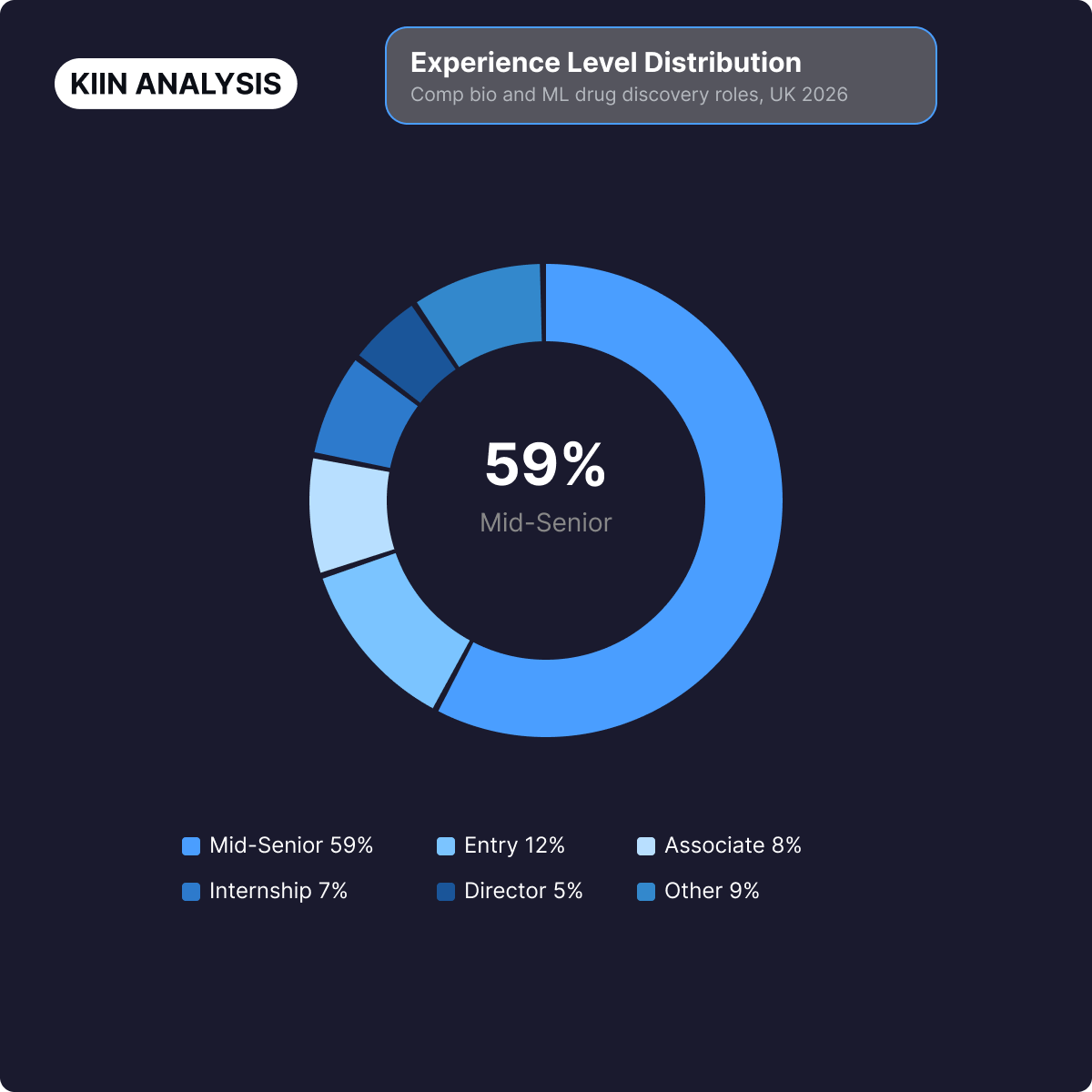
Bioinformatics (355 roles): The broadest category, spanning clinical bioinformatics, genomics, spatial and single-cell analysis. Also the most accessible at entry level: 33% of bioinformatics listings are entry-level, compared to just 12% in ML drug discovery. For early career candidates, this is where the door is most open, across both big pharma and smaller biotech. Startups tend to offer faster progression and broader scope; pharma offers stability and established infrastructure.
Computational biology (164 roles): Core comp bio and adjacent research scientist roles. Spans both pharma and biotech.
ML in drug discovery (137 roles): Protein design, ADMET prediction, molecular modelling. Isomorphic Labs dominates with 21 positions, followed by Relation Therapeutics with 16. Newer players like CuspAI and Boltz have also been hiring heavily over the past 12 months. Small in absolute numbers, but likely one of the fastest-growing categories year on year: the AI in drug discovery market is expanding at around 25% annually (Verified Market Research). Even if the number of roles today looks modest, the trajectory and the funding flowing in suggest this will look very different by 2028. The roles that exist here tend to be senior, well compensated, and competitive.
Clinical AI (~500 roles): The broadest umbrella, covering health informatics through to clinical data science.
AI protein design (9 roles): Tiny, highly specialised, and almost exclusively mid-senior level.
The other trend Joe flags: forward-deployed engineers and technical client facing hires. “A lot of companies are commercialising scientific ML platforms now rather than running their own therapeutics pipelines, so they need engineers and scientists who can comfortably operate across product, research, and client conversations.” GTM hiring is picking up too as firms move beyond pure research mode.
📍 Geography: the Golden Triangle and beyond
If you’ve been paying attention to the London tech scene, the top of this list won’t surprise you.
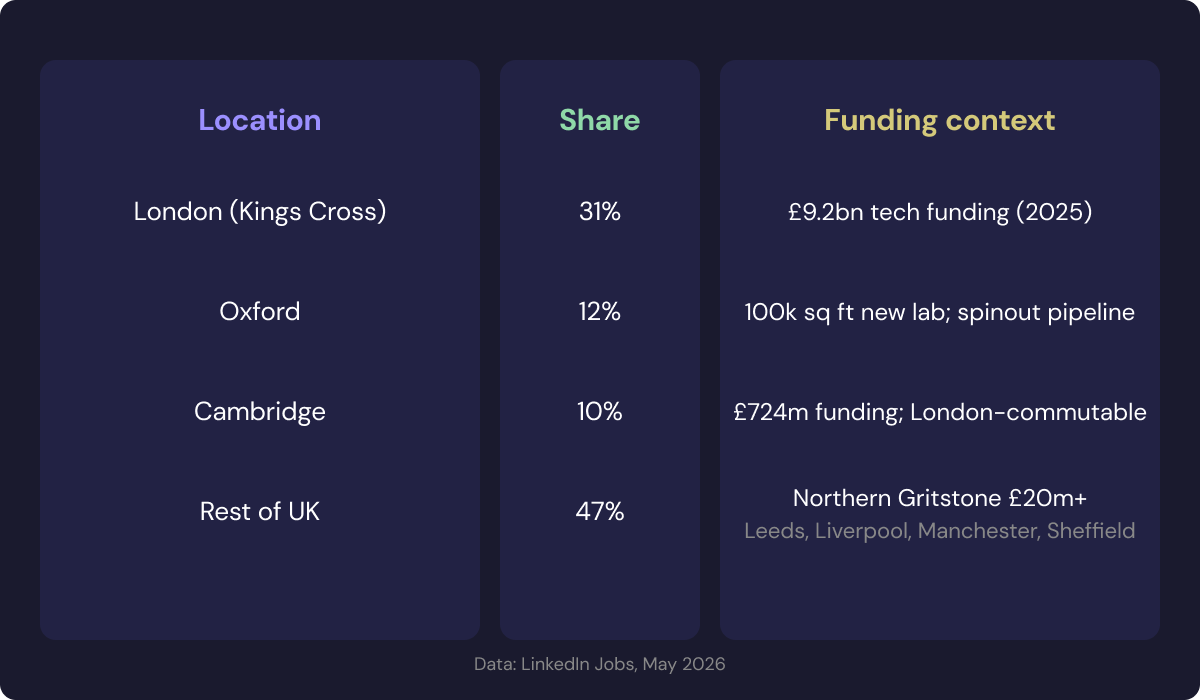
“Kings Cross is obviously on fire at the moment,” says Joe. “Oxford and Cambridge are also hotspots, although of the two, Cambridge is always an easier sell to candidates because of the commutability from London.”
Outside the Golden Triangle, the Northern Arc (Leeds, Liverpool, Manchester, Sheffield) is showing up as a secondary cluster, backed by Northern Gritstone funding for life science and deep tech spinouts. Glasgow also appears consistently in bioinformatics listings, driven by NHS Scotland roles. For candidates willing to look beyond the south-east, the cost of living advantage is real, particularly when London salaries don’t always come with a proportional premium.
💰 What it pays
So where do these 2,000+ roles sit on salary? UK data for comp bio is notoriously thin, which makes it hard for candidates to know when an offer is fair. Joe shared benchmarks from his recruitment work:
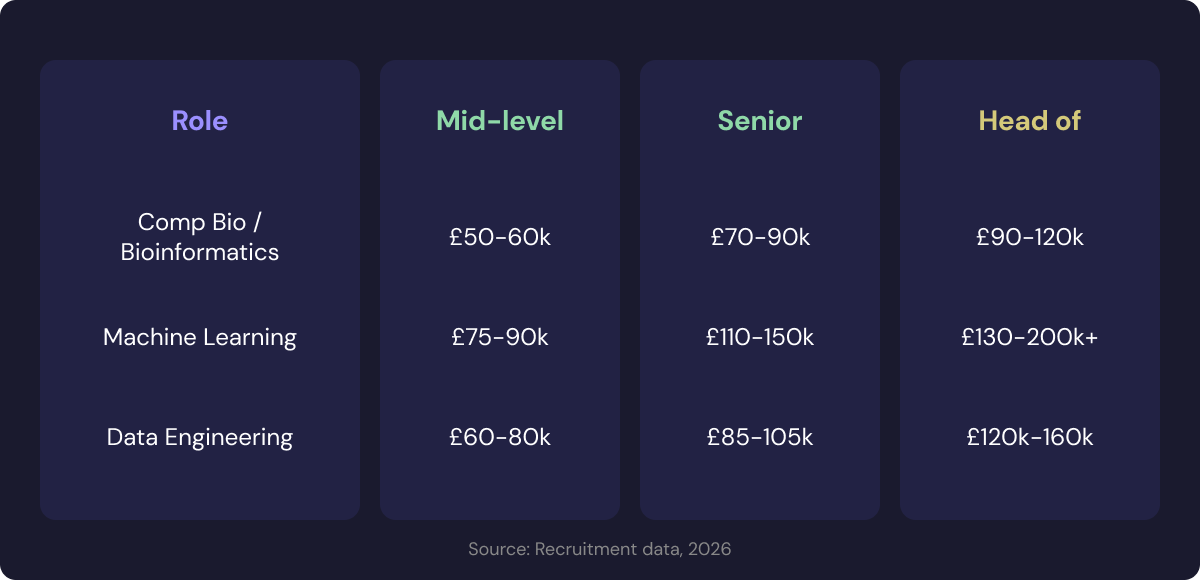
The ML premium is hard to ignore. A senior ML engineer in biotech can earn nearly double what a senior bioinformatician earns. That comes down to scarcity of strong ML talent and the direct commercial impact these roles carry: GPU optimisation and inference efficiency directly affect a company’s burn rate.
Joe’s caveat: “This can massively depend on the size of the company and what they are working on. There are always outliers.” Community data backs this up. Biotech equity is less liquid than FAANG RSUs, so even when base salaries match, total compensation often lags tech. The trade-off is mission, ownership, and the fact that senior bio-AI roles are closing the gap faster than any other life sciences category.
🏠 Remote, hybrid, or on-site?
Many comp bio professionals came up during the pandemic era of fully remote work, so this question comes up constantly. The answer depends on what you actually do day to day.
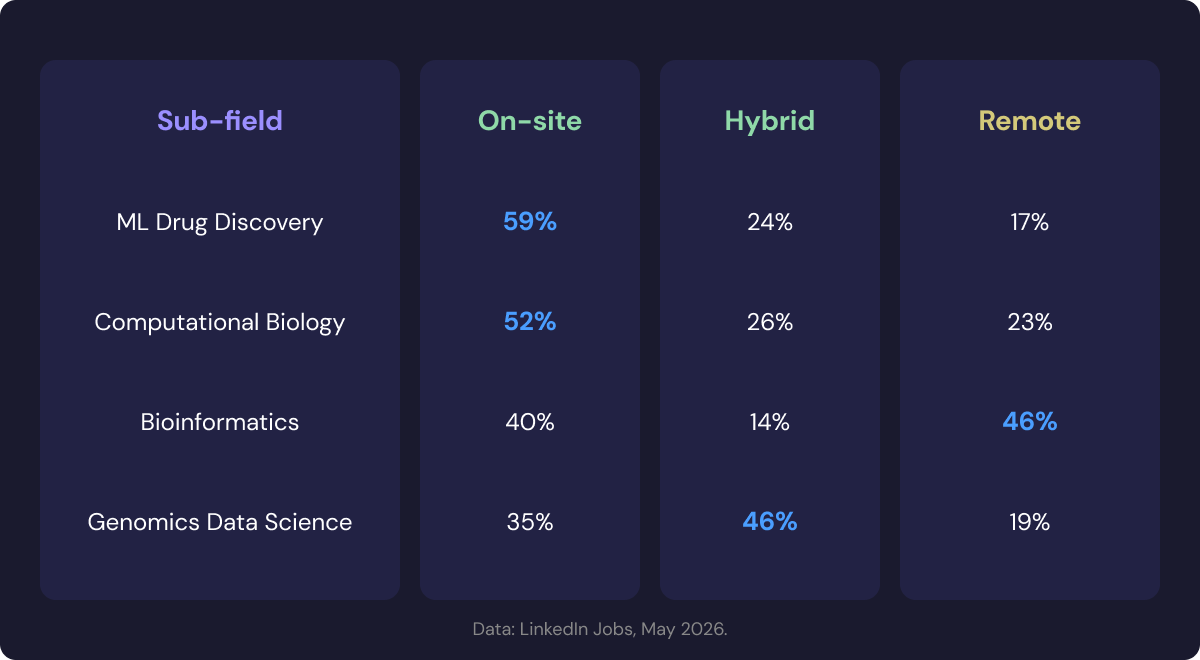
Bioinformatics is the outlier for remote work (46%), probably because much of the work is pipeline-based and can run independently. Drug discovery and comp bio skew heavily in-person, particularly at early-stage companies where wet lab and dry lab collaboration matters daily.
“Fully remote roles are still fairly rare,” says Joe. “If anything, more companies are trying to get people together in person more, especially at earlier stages where collaboration between science and engineering matters a lot.”
In practice, remote flexibility correlates strongly with sub-field. Bioinformatics and genomics data science offer the most options; ML drug discovery is almost entirely on-site.
🛠️ Skills that matter now
The roles exist and the salaries are there, the question is really just what actually gets you through the door as the technical bar has moved. Python is the most used programming language in the world (GitHub’s 2024 Octoverse report placed it at number one for the first time, overtaking JavaScript). R remains critical for statistical genomics. Beyond the basics, what actually separates candidates falls into three tiers.
Table stakes (expected, not differentiating):
Python, R, Bash/Unix
Git, Docker, AWS or GCP
Basic ML (regression, classification, clustering)
Differentiators (what gets you to the top of the pile):
GPU optimisation and distributed systems (the single most in-demand infrastructure skill right now)
JAX proficiency (driven by the DeepMind/Isomorphic ecosystem)
Production ML deployment (Kubernetes, inference optimisation)
Cross-functional communication: being able to sit across product, research, and client conversations
Emerging (bet on these for 2027):
Diffusion models for molecular generation (e.g. DiffDock, FrameFlow)
Geometric deep learning and equivariant neural networks
LLMs for biomedical data (RAG architectures, agentic AI for research)
Foundation models for genomics (single-cell, spatial transcriptomics)
PyTorch has decisively won over TensorFlow in bio-AI research. JAX has gone from niche to essential for structural biology. Perl has disappeared from modern curricula entirely. The field moves fast enough that what was cutting-edge in 2023 (basic AlphaFold usage) is now baseline knowledge.
What we think: The agentic AI category is the one to watch. Right now, “agentic” is mostly a buzzword on job listings. Within 18 months it will be a real job requirement, because the companies that figure out how to automate their literature review, hypothesis generation, and experimental design pipelines will move significantly faster than those relying on manual researcher effort. If you’re picking a side project to build in public, an agentic research workflow is probably the highest-signal thing you could show a hiring manager right now.
🎯 How to stand out as a company and an employee (from someone who sees 1,000 CVs)
Knowing the right skills is one thing, betting noticed in a pile of 300 applicants is another. The entry-level bottleneck is worth spelling out from both sides. Candidates are applying into a tiny number of junior roles: only 11-12% of ML drug discovery and comp bio positions are entry-level, yet the pipeline of qualified graduates is enormous. Joe puts numbers to it: a senior role might attract 50 applicants, of which maybe one is genuinely relevant. A junior role pulls 300-350, of which 7-10 are a real fit. The ratio of applicants to roles is 6-7x higher at entry level, and even then, most applications miss the mark. Companies, meanwhile, are drowning in applications and still can’t find the right people. The volume of inbound is high; the signal-to-noise ratio is low.
Joe’s advice on what separates the top candidates:
Show evidence of building, not just researching. “Founders and hiring teams often love seeing evidence that someone can actually build and ship things, not just research them theoretically. Particularly in bio, there’s a real appreciation for candidates who can move between experimentation and execution.”
Be visible where recruiters actually look. This goes beyond LinkedIn. “A huge chunk of our time is tracking publications and collaborations to map who’s working on what, which labs are producing interesting work. There’s also GitHub and Hugging Face, where we’re digging through models, software tooling and tech stacks.” Active repositories, conference contributions, hackathon results, and community involvement all increase visibility.
Go deep in interviews, not broad. “A lot of candidates stay very high-level when explaining their work, but hiring teams usually want to go much deeper than people expect. They want candidates to talk through how decisions were made, why certain approaches worked.” Approach interviews like an external consultant: figure out exactly what you are there to improve.
Bridge the academia-industry gap deliberately. “Where people sometimes struggle is around product and commercial awareness. Industry teams aren’t just thinking about whether something works academically. They’re thinking about usability, timelines, scalability, deployment and business impact.” The candidates who transition best have already sought out internships, collaborations, or commercial projects while in academia.
Network into the hidden job market. “The people most in-demand tend to have clear signals that they’re genuinely interested in their area outside their day job. They’re naturally around others in the space a lot of the time, so are closer to that hidden job market that’s often rife with word-of-mouth opportunities.”
What we think: The pipeline problem in comp bio is structural, not cyclical. Universities produce graduates faster than the industry can absorb at junior level, while senior roles go unfilled for months. This won’t close by itself. The people who break through are the ones who’ve already demonstrated they can operate above their experience level. A polished GitHub with one well documented, production quality project is worth more than five papers in middling journals. Hiring managers are pattern-matching for “can this person ship something on day one,” and the evidence needs to be visible before the interview.
🏢 For companies: how to compete for talent
Now the contrary. If you’re a hiring manager or founder reading this, you already know the challenge. You’re getting hundreds of applications per role and still can’t find the right people. Startups are competing with Isomorphic Labs (£1.6 billion raise in 2025), Google DeepMind, and Boltz for the same small talent pool. Joe’s take on what works:
“A lot of candidates want more ownership, closer access to founders, more influence over direction of a product, and thrive on the ability to actually see their work shape a product directly. The larger players cannot offer this at the same level.”
Smaller companies can lean into that. What the ones that hire well do differently:
Clarity of mission: Strong conviction about what they are building and why it matters. “If people believe in the founding team and what they’re standing for, it counts for a lot.”
Process efficiency: “Slow feedback, too many stages, or technical tasks that take hours of a candidate’s time can quickly put people off.” Even unsuccessful candidates should leave with a good impression.
Communication throughout: “Companies sometimes assume that if there’s no update, there’s no reason to contact the candidate. From the candidate’s side, silence feels like being ghosted.” Even an update saying they are still in consideration keeps people engaged.
Clear expectations: “So often role details change mid-search, sometimes several times, which sends a mixed message to market and damages perception to the target talent pools.”
What we think: The talent competition in bio-AI is asymmetric in a way that favours startups, if they play it right. The big players offer prestige and salary. They cannot offer speed, ownership, or the feeling of shaping something from scratch. The startups that lose candidates to Isomorphic or DeepMind are usually the ones that ran a slow, unclear process, not the ones that lost on compensation alone. Your hiring process is your first product demo. If it’s confusing or inconsistent, strong candidates will read that as a signal about what working there is actually like.
⚡ The market in motion
Two things are true at the same time in computational biology right now. Traditional pharma is contracting (patent cliffs, layoffs, restructuring), while AI-native biotech is expanding fast. Isomorphic Labs raised £1.6 billion with no molecules in clinical trials. UK seed investment leapt 19% in 2025. Two UK biotech companies hit unicorn status (Verdiva Bio and Isomorphic Labs). The computational biology market overall is growing at 13% annually toward $22 billion by 2034.
For candidates, the opportunity is real, but “learn Python and apply broadly” doesn’t work anymore. The market rewards specialists who can ship production systems and communicate across disciplines. Infrastructure roles (MLOps, GPU optimisation, deployment) are where the most acute demand is. The salary premium for ML over traditional bioinformatics is widening. Remote work exists, though it’s not the default.
The people who do best in this market aren’t necessarily the most credentialed. They tend to be the ones who are visible, who adapt quickly, and who build things in the open.
💬 Want to be featured in Kiin Bio Weekly?
Each issue we speak directly with researchers, scientists, and builders working at the frontier of AI in life sciences. If you're working on something in this space and think it would resonate with our community, I'd love to hear from you. Fill out this form or reach out to me directly.
Found this useful? Forward it to a colleague in computational biology, it's the best way to help the newsletter grow.
Subscribe now to stay at the forefront of AI in Life Science. Every week: primers, deep dives, and direct conversations with the people building the field.
Connect With Us
Have questions on this or suggestions for our next deep dive? We’d love to hear from you!
📧 Email Us | 📲 Follow on LinkedIn | 🌐 Visit Our Website