

Welcome back to the deep dive, where we break down the AI tools and data reshaping how new drugs are discovered. In each edition, we speak directly with the teams behind these tools to explain what they solve, how they work and where they are going next.
What’s your biggest time sink in early drug discovery process?
Why binder design feels easy on paper, and hard in practice
Protein binder design is having a moment. Diffusion models can sketch backbones from noise. Sequence models can fill them in with confidence. Structure predictors can tell you whether something is likely to fold and bind.
From the outside, it looks almost routine.
But when we spoke with the BinderFlow team, the story sounded very different. Less about clever architectures, more about queues, shared clusters, and the quiet politics of GPU time.
“We’re a structural biology lab, not a protein design lab,” Carlos Chacón told us. “We don’t have massive infrastructure. We have to share.” BinderFlow grew out of that reality. Not as a new model or a flashy algorithm, but as a rethink of how protein binder design actually runs in day-to-day academic labs.
🔴The problem: protein design workflows weren’t built for real labs
Modern binder design pipelines are powerful, but they tend to assume ideal conditions. Plenty of GPUs. Long uninterrupted runs. Teams who are happy to babysit jobs for days.
In practice, many labs do not look like that.
Carlos described the early frustration plainly. Running large design jobs meant occupying cluster nodes for days at a time. Structural biology workflows stalled. Cryo-EM processing had to wait.
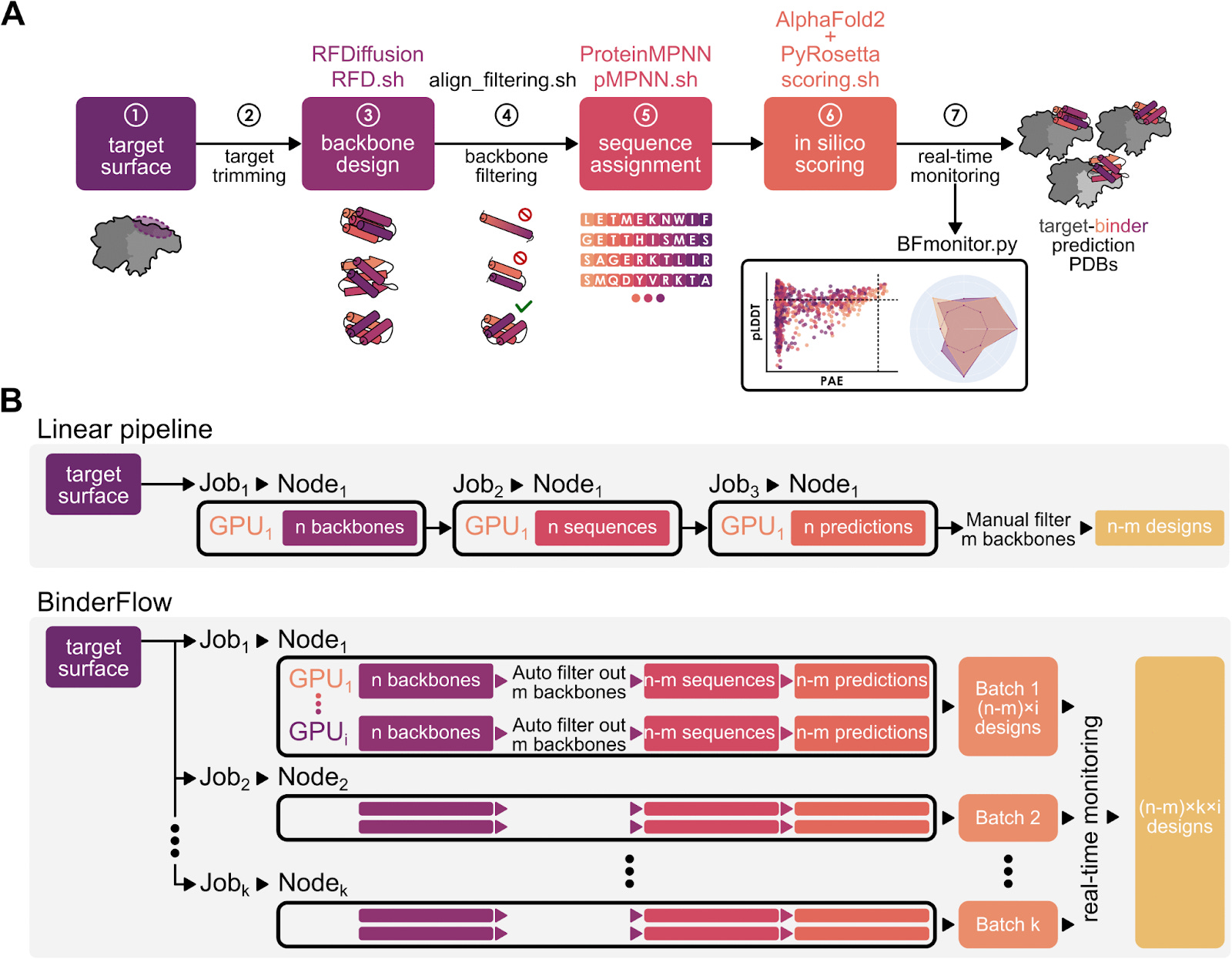
The underlying issue is structural. Traditional workflows are linear. You generate thousands of backbones, then thousands of sequences, then score everything in one long chain. The hit rate is unknown upfront, so you either overproduce and waste compute, or underproduce and have to rerun jobs.
For smaller labs, that cost adds up quickly. Without visibility into how a campaign is progressing, decisions come late. You only discover something failed after days of GPU time are already gone.
💡The approach: breaking binder design into batches you can actually live with
BinderFlow’s core idea is simple. Instead of running one huge design job, you split the campaign into many small, independent batches. Each batch runs end to end. Backbone design. Sequence assignment. Scoring. Reporting.
“You can follow the process in real time,” Carlos explained. “If a campaign is not working, you stop early. You don’t overuse the GPUs.”
Small batches can coexist with other GPU-heavy workflows. They can run opportunistically. They do not need to dominate the cluster to be useful.
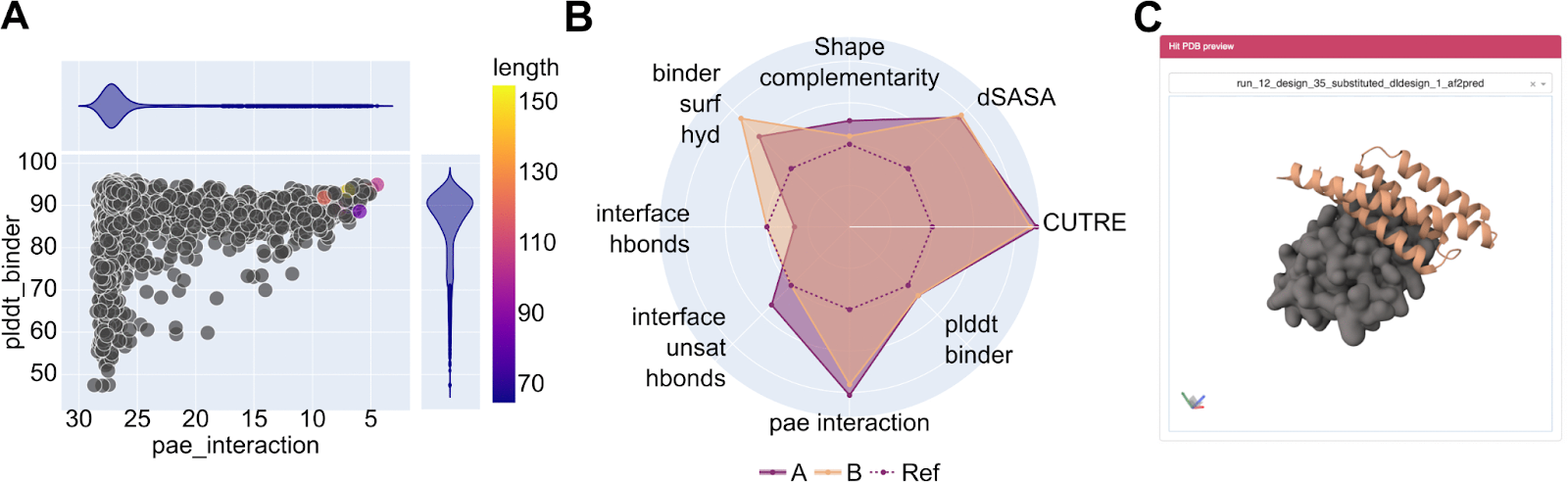
To make that visibility practical, the team built BFmonitor. It’s a web-based dashboard that updates as designs are scored. You can watch metrics change live, inspect structures, compare candidates, and decide when you’ve seen enough.
Carlos mentioned drawing inspiration from cryo-EM tools like cryoSPARC and RELION Live. Structural biologists expect to monitor data as it’s collected. BinderFlow brings that mindset into protein design.
🔬Why it’s different: designing around people, not just GPUs
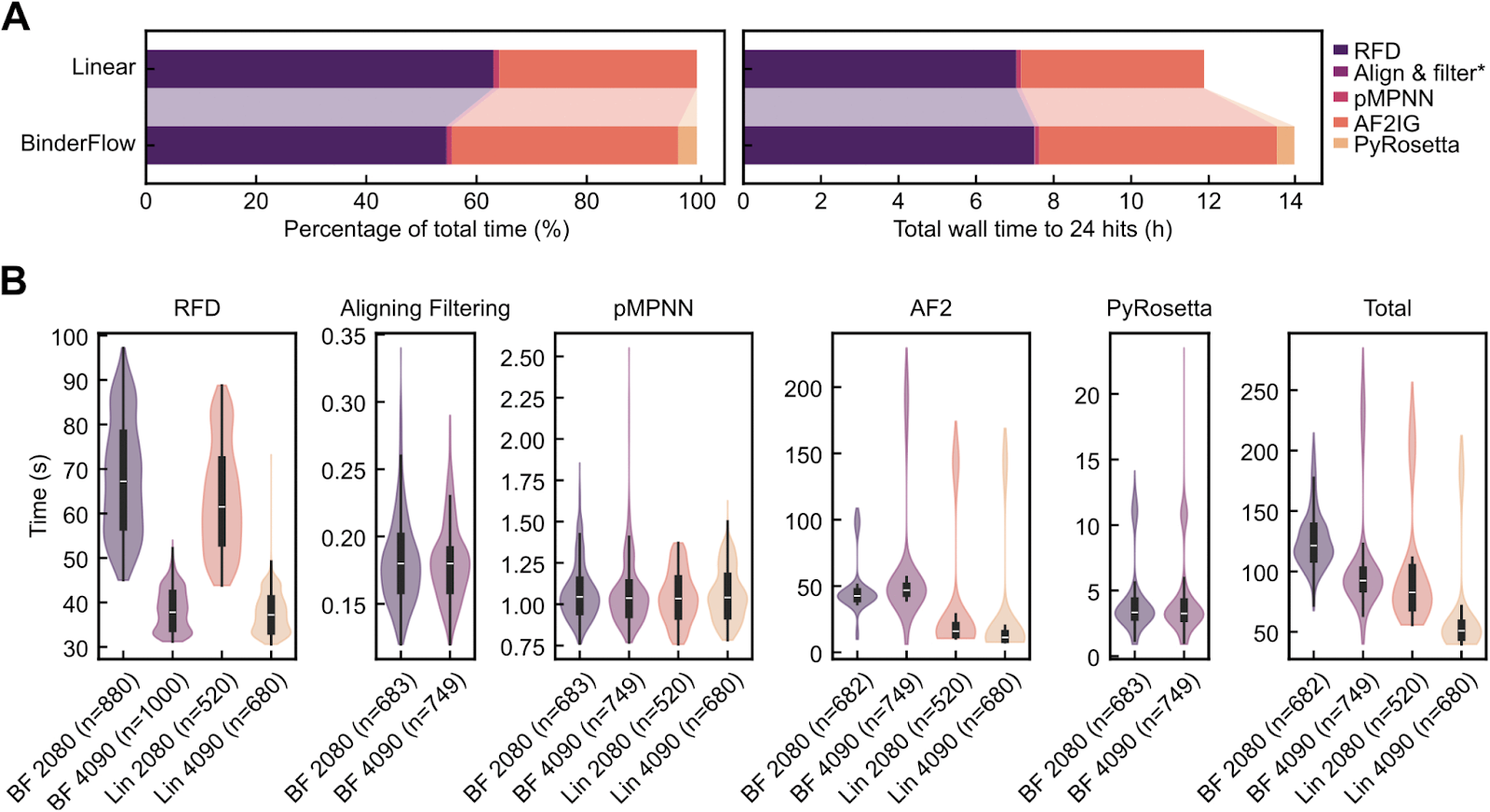
BinderFlow is careful about what it claims. It does not promise to be faster in every case. Splitting work into small batches can increase per-design overhead, particularly during structure prediction.
What matters is what happens in practice.
Live monitoring means you rarely compute more designs than you can realistically test. Automatic backbone filtering means fewer weak candidates move downstream. In real lab settings, that often saves more time than raw throughput ever could.
The same philosophy shows up in how the team thinks about metrics. Early on, they relied on standard interaction scores. But flexible targets exposed problems.
“The interaction score was skewed by flexible loops,” Carlos said.
That led to the development of a weighted interaction metric that accounts for prediction confidence at the residue level. It is particularly useful for dynamic or poorly ordered regions, where traditional scores can mislead.
The team is open about the limits here. Metrics are target-specific. No single number guarantees success. BinderFlow surfaces that uncertainty instead of hiding it behind rigid thresholds.
There is also a clear design choice not to train new models. BinderFlow is about orchestration, not replacement. Its modular structure means new backbone generators, sequence models, or scoring tools can be swapped in as the field evolves.
“Each week there’s a new model,” Carlos said. “We want to stay flexible.”
🔮The future: modular, open, and a little more humane
Looking ahead, the BinderFlow roadmap focuses on removing friction. Containerisation using workflow tools like Snakemake or Nextflow is a priority. The team also wants BFmonitor to become a standalone application. As generative models mature, the hardest part of protein design is no longer knowing how to design. It is knowing what to design, and how to validate it well.
BinderFlow does not solve target selection. It does not replace experimental insight. But it lowers the barrier to engaging with those questions.
“You don’t need to be a bioinformatician anymore,” Carlos said. “You select a target, define hotspots, start a campaign.” That change is subtle, but important. BinderFlow is not about pushing protein design to extremes. It is about making powerful tools fit more naturally into the way real labs already work.
Not louder. Not flashier. Just more usable.
📄 Read the paper!
⚙️ Access the model on Github.
👨🔬 Get in touch with Carlos.
Thanks for reading Kiin Bio Weekly!
💬 Get involved
We’re always looking to grow our community. If you’d like to get involved, contribute ideas or share something you’re building, fill out this form or reach out to me directly.
Subscribe now to stay at the forefront of AI in Life Science and keep up with this upcoming season of deep dives.
Connect With Us
Have questions on this or suggestions for our next deep dive? We’d love to hear from you!
📧 Email Us | 📲 Follow on LinkedIn | 🌐 Visit Our Website