
Memorial Sloan Kettering's ScreenShot, Zhejiang University's RetFold, and UNC Chapel Hill's SABLE
Kiin Bio's Weekly Insights

Welcome back to your weekly dose of AI news for Life Science! This weeks fix:
A foundation model that predicts combination drug responses from a handful of measurements, no molecular profiling required, and cuts the screening budget by two-thirds.
A paper that asks a question nobody in protein design wants to hear: are your diffusion models actually generating novel structures, or just reassembling known domains?
An open-source agentic framework that wraps the entire hit-to-lead optimisation cycle in natural language, constraining every suggestion to molecules you can actually synthesise.
You read this newsletter because staying current in AI x life science matters to you, it matters to us too. That's why we're building a free personalised resource for the community: from papers, patents, and clinical trials to c-suite career moves and job opportunities. So you can stay up to date with what actually matters to you.
We want to know: where else are you looking? What's missing? Two minutes of your time will shape what gets built.
ScreenShot: A foundation model for few-shot combination drug screening
Why This Is Cool
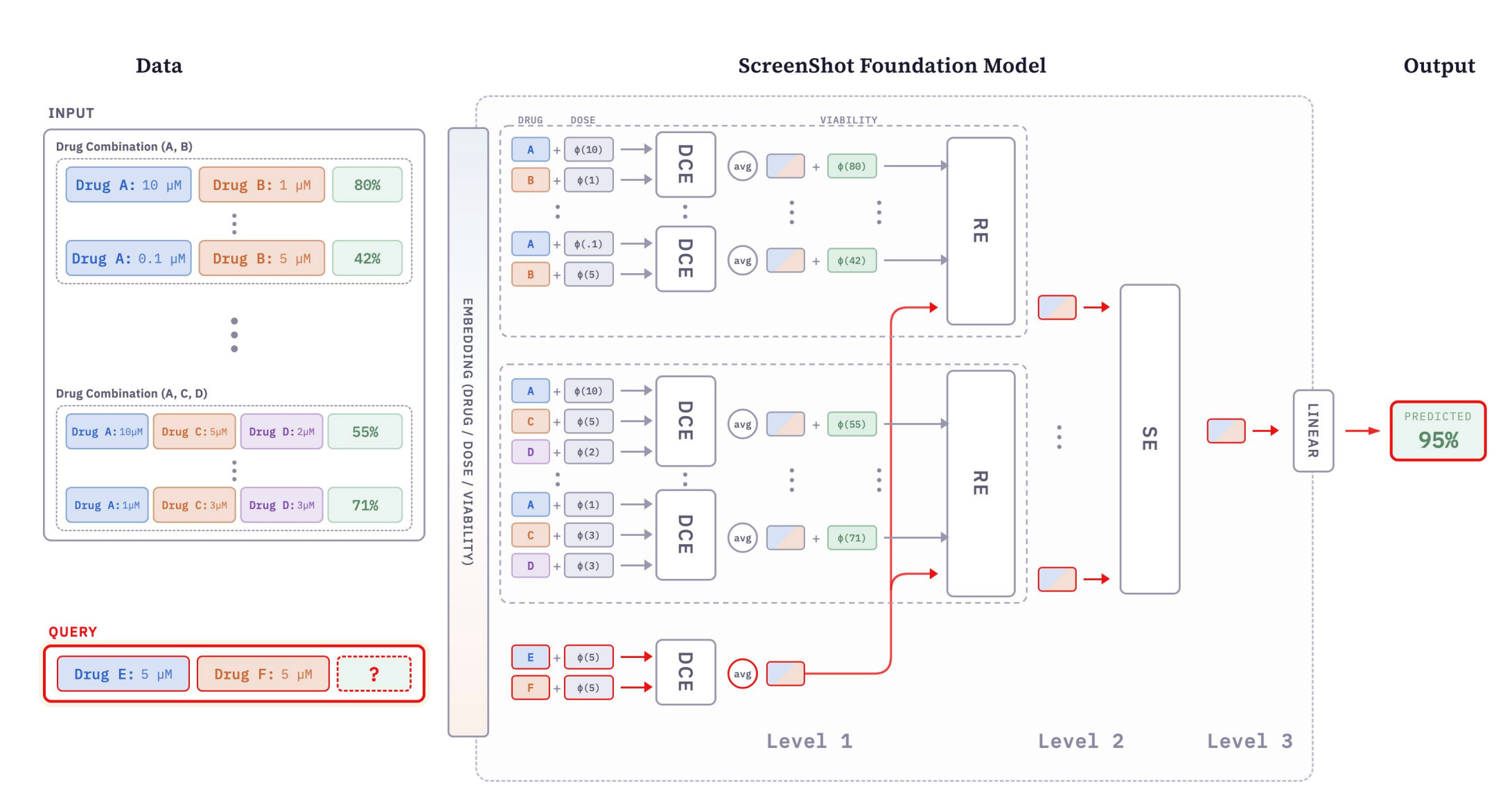
Two-thirds. That is how much of your experimental screening budget ScreenShot claims you can skip. The model picks which drug combinations to test next using a weighted k-means++ active learning strategy over its own internal representations, and the resulting subset matches the hit detection rate of screening everything uniformly. For combination screens, which grow exponentially with the number of drugs, this is the difference between a tractable experiment and one that never gets run.
What It Is
Antoine de Mathelin, Christopher Tosh, and Wesley Tansey built a hierarchical transformer pretrained on 40 drug screening datasets covering 3,700 drugs and 6,000 biological samples. The architecture mirrors the nested structure of screening data itself: drugs within combinations within samples within cohorts. Given a few observations from a new patient sample, ScreenShot predicts responses to unseen combinations through in-context learning. No fine-tuning. No molecular profiling. No omics data needed at inference time.
On four held-out datasets it outperformed all baselines for both prediction accuracy and selective hit identification. The code, pretrained models, and an interactive dashboard are all public.
Where This Fits
Combination drug response prediction has been attempted before. DrugComb provides the data. Models like DeepSynergy and comboFM have tried learning from molecular features. The problem is that they all require molecular profiling of each sample and retraining for each new cohort. In a clinical setting where tissue is limited and time is short, that is often not possible. ScreenShot sidesteps the requirement entirely by working from functional measurements alone, treating the problem as an in-context prediction task rather than a supervised one.
I think the active learning component is where the real value sits. Predicting drug response is useful, but telling a lab which 30 experiments out of 100 candidates will give them the most information is operationally transformative. Worth watching whether clinical groups adopt this for patient-derived organoid screens, where the combinatorial explosion is worst and tissue is scarcest.
Is Retrieval All You Need? Assessing novelty in protein structure generation
Where This Fits
Everyone working on protein backbone generation, from RFdiffusion to Chroma to FrameFlow, claims to generate “novel” protein structures. The field has implicitly assumed that diffusion and flow-matching models explore genuinely new fold space because the outputs look different from individual training examples. Tongyue Xu, Cheng Tan, and colleagues at Zhejiang University decided to actually test this.
What It Is
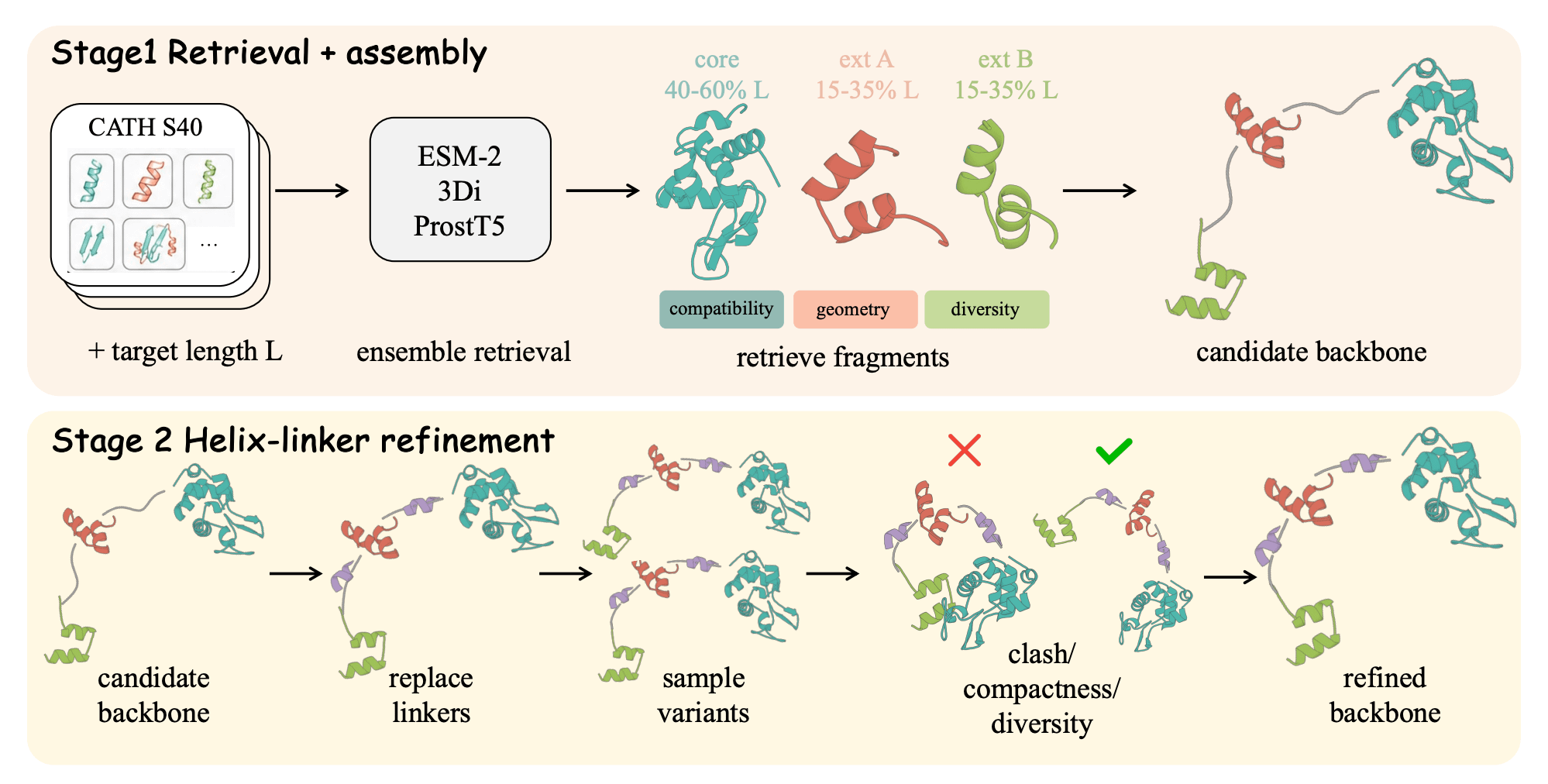
They introduce Domain Retrieval Rate (DRR): a metric that measures how many generated backbones contain a constituent domain alignable to a known domain in CATH S40, the standard hierarchical classification of protein folds. They ran eight backbone generators through this analysis.
The finding: most generated structures contain locally alignable known domains. The models are recombining existing structural vocabulary rather than inventing new words. The fraction containing a complete known domain varies by method and scoring stringency, but the pattern held across all generators tested.
Then they built RetFold. It retrieves existing CATH domains and refines inter-domain connections through geometry-based helix-linker optimisation. No neural network. No training. It runs on CPU and achieves competitive designability and diversity metrics at roughly 1/100th the compute cost of learned methods.
Why This Is Cool
This paper will annoy people, which is usually a sign it needed to be written. The protein design community has invested heavily in generative models, and showing that a retrieval baseline with linker optimisation matches their outputs on standard metrics is uncomfortable. It does not mean those models are useless. It means the metrics we use to evaluate them might not be measuring what we think they are measuring. If “novel” structures are really recombinations of known domains with new linkers, then a retrieval approach is arguably more honest about what it is doing.
I would not overstate the conclusion. Generating smooth, well-packed backbones that fold reliably is still hard, and learned models likely have advantages for conditioned generation tasks. Still, if your evaluation of a protein generator relies on it “exploring new fold space,” this paper says: prove it.
SABLE: Agentic hit-to-lead optimisation with synthetic feasibility constraints
What It Is
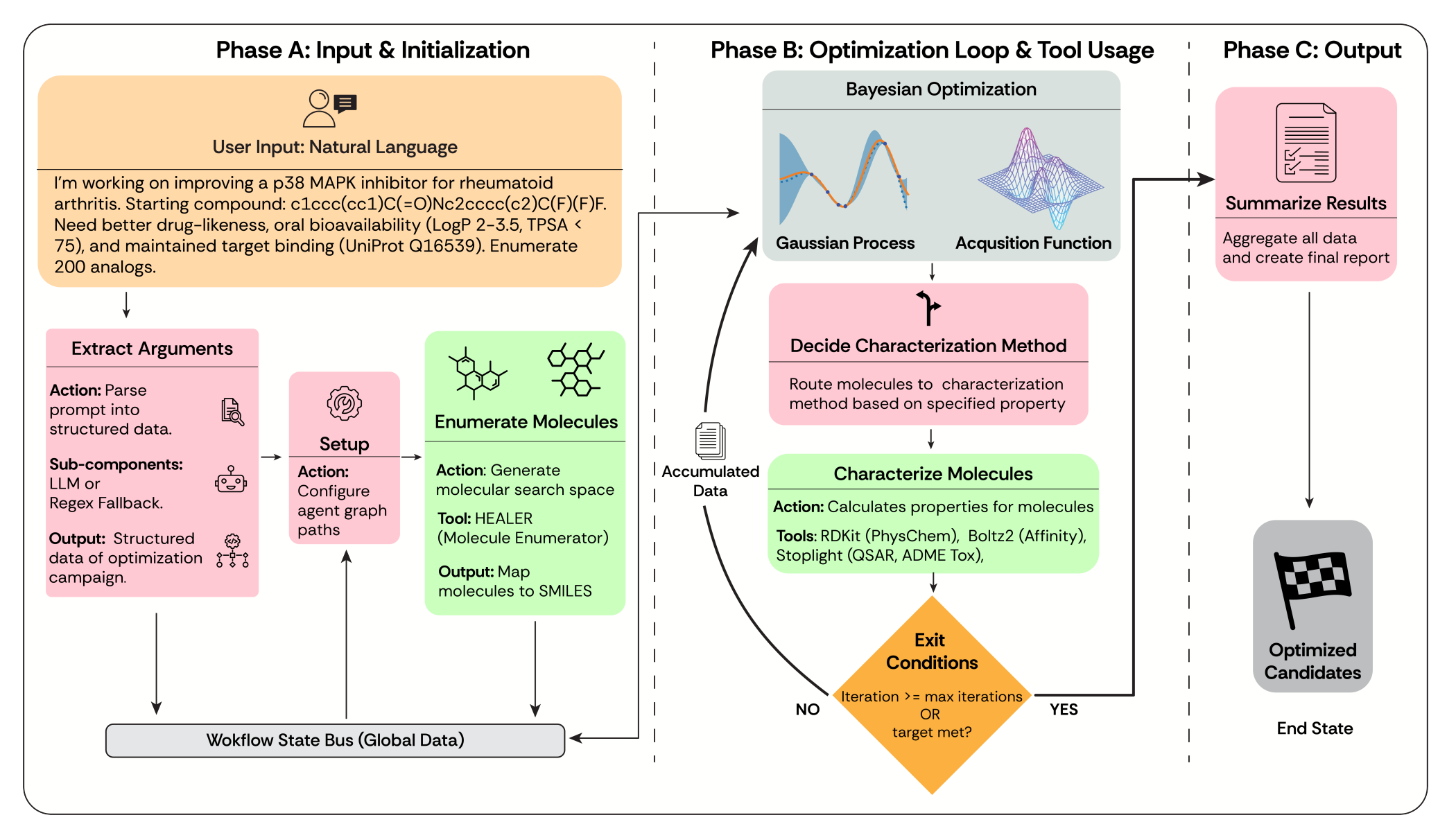
Hit-to-lead optimisation is iterative and multi-objective: you are simultaneously chasing potency, selectivity, ADMET properties, and synthetic accessibility, often across hundreds of candidate structures. Kelvin Idanwekhai, Alexander Tropsha, and collaborators at UNC Chapel Hill built SABLE (Synthetically-accessible Agentic Bayesian Ligand Exploration) to automate the analytical and prioritisation stages of this cycle. An LLM interprets the optimisation objectives in natural language, then routes tasks across four specialised modules:
Reaction-templated analog enumeration
Physicochemical and ADMET property prediction
Structure-based affinity scoring
Bayesian optimisation for candidate selection
Every proposed compound comes from a real reaction template. If it cannot be made, it never enters the candidate pool.
Where This Fits
Generative chemistry tools are everywhere now. REINVENT, SyntheMol, and others generate optimised molecules. The persistent complaint from medicinal chemists is that most suggestions are synthetically impractical. SABLE addresses this by constraining the search space to reaction-accessible analogs from the start rather than filtering after generation. The modular architecture also means any component can be swapped via a config file: different scoring functions, different property predictors, different reaction databases.
Why This Is Cool
The “agentic” framing could easily be dismissed as a buzzword, but the implementation detail that matters is the natural language interface to multi-objective optimisation. A chemist can specify “improve selectivity over hERG while maintaining sub-100 nM potency against CDK2, prioritise compounds with fewer than 3 synthetic steps” and the system translates that into a constrained optimisation run. Whether this actually saves time over a well-configured traditional pipeline is an empirical question the paper does not fully answer, but the barrier to entry drops substantially.
The framework is open-source and modular enough to be useful even if you only want one piece of it.
🗓️ Events & Competitions
The best competitions, hackathons, and community challenges in AI x life sciences, curated weekly. Know something worth featuring? Reply and let us know.
More upcoming events:
BioHackathon Europe 2026 | November 9-13, Barcelona
ELIXIR’s annual international bioinformatics hackathon, running since 2018. 160+ participants, five days of collaborative coding on open bioinformatics infrastructure and tools. The call for project proposals has now closed.
Thanks for reading!
💬 Get involved
We’re always looking to grow our community. If you’d like to get involved, contribute ideas or share something you’re building, fill out this form or reach out to me directly.
Connect With Us
Have questions or suggestions? We'd love to hear from you!
📧 Email Us | 📲 Follow on LinkedIn | 🌐 Visit Our Website