
NYGC's Pan-human Azimuth, Zheng Lab's AAMFM, and Meijers Lab's ML-aided antibody platform
Kiin Bio's Weekly Insights

Welcome back to your weekly dose of AI news for Life Science! This weeks fix:
Pan-human Azimuth is what happens when you take Azimuth and make it work across the entire human body at once. 27 million cells, 23 tissues, one unified hierarchy. From Satija Lab at the New York Genome Center.
AAMFM builds on ESM3 to design antibody CDR loops conditioned on the actual antigen structure. The key move is using direct preference optimisation with structural priors to steer designs toward binding.
The Meijers and Marks labs built a minimal synthetic antibody library from scratch, screened it against ten cell surface targets, then used logistic regression to rescue binders that the experimental selection missed. The dataset is public and ML-ready.
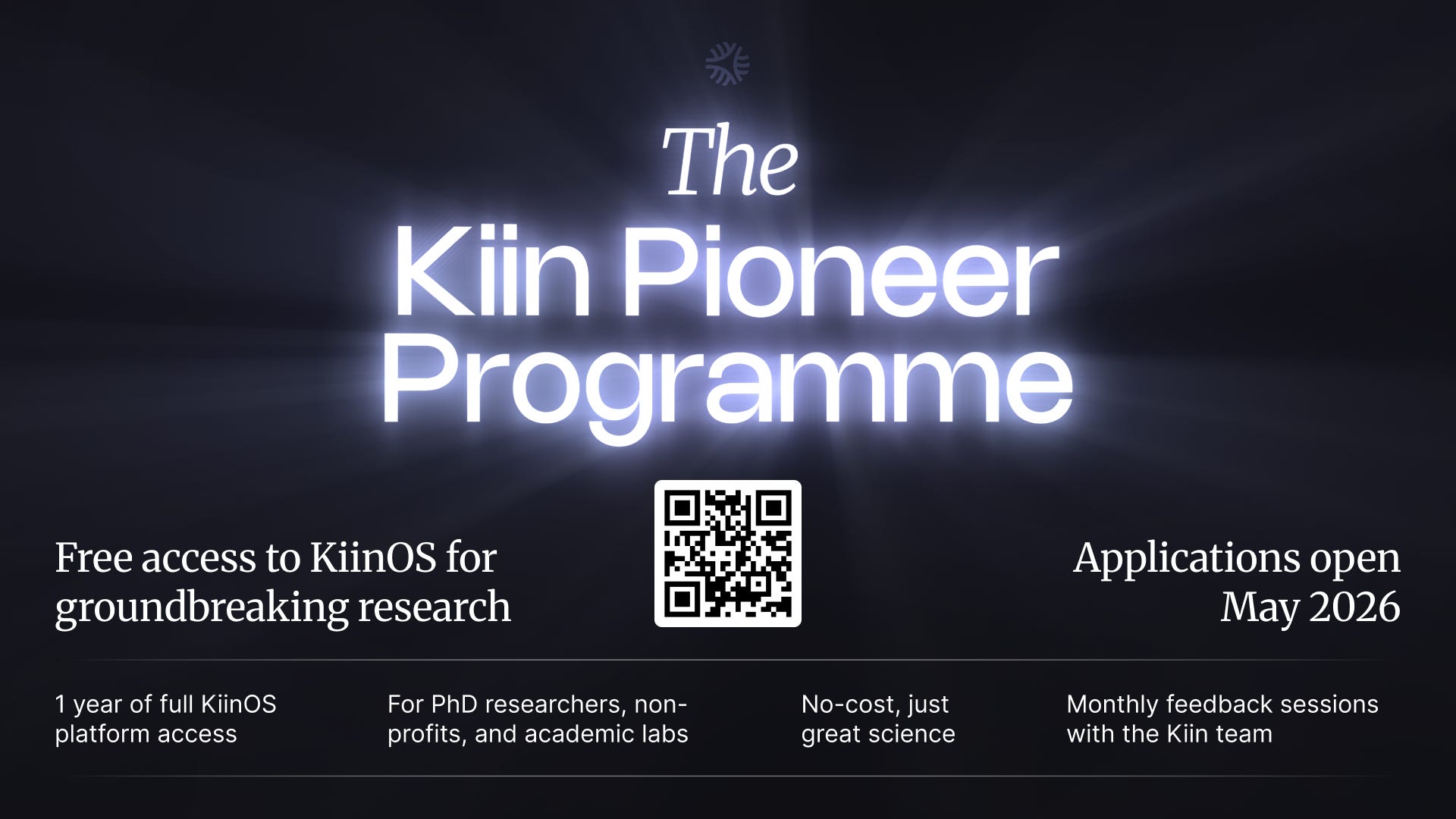
Kiin Pioneer Programme
We built a platform that helps researchers speed up their entire science, from literature review and biomarker discovery to bioinformatics and computational chemistry. If your workflow involves pulling findings from five different places before you can actually act on any of them, this is for that.
The Pioneer Programme gives academic labs and non-profits one year of free access, plus support from our science team. No cost, no data transfer, all IP stays with your institution. Applications close August, cohort starts September.
Pan-human Azimuth: Organism-scale annotation with a unified cell type hierarchy
Where This Fits
If you work with single-cell data you have probably used Azimuth at some point, or one of the tissue-specific references it relies on. The problem is that those references are built per-organ. A lung reference does not talk to a kidney reference. The labels are inconsistent across tissues, the hierarchies are different, and if you want to compare immune populations across organs you are stuck reconciling vocabularies by hand. scGPT and SCimilarity attempt organism-wide annotation through foundation models, but recent benchmarks show they produce noisier labels with fragmented cell type assignments. Pan-human Azimuth takes the supervised reference-mapping approach and scales it to the whole body.
What It Is
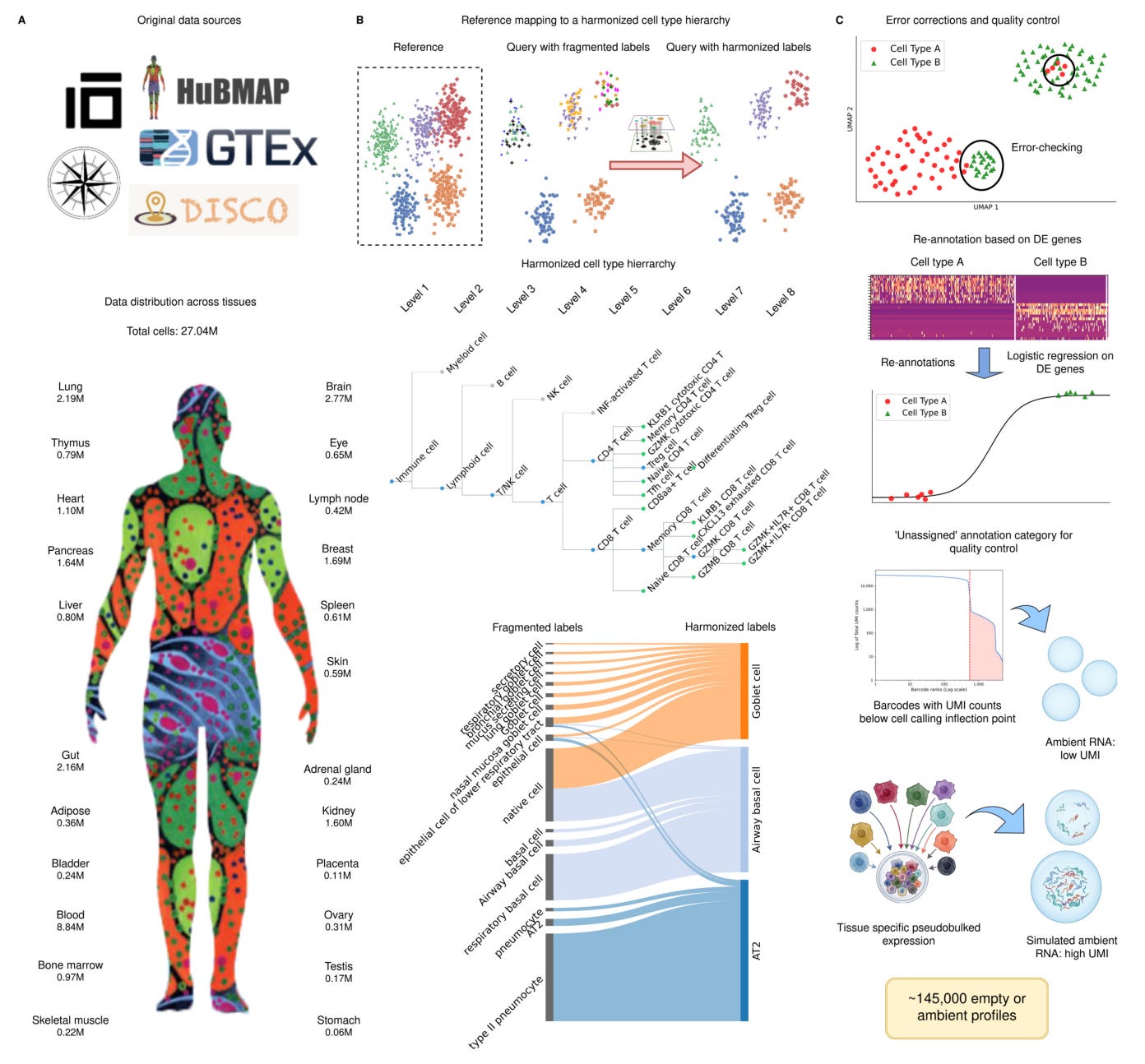
Sourav Sarkar, Zhuoyan Li, Rahul Satija, and colleagues at the New York Genome Center and collaborating institutions built a supervised neural network classifier trained on 27 million cells from 23 tissues. The training data was assembled from Azimuth references, DISCO, CELLxGENE, GTEx, and HuBMAP, then systematically re-annotated onto a single hierarchical cell type tree built on the DISCO typology with Cell Ontology mappings. Every cell gets up to eight levels of hierarchical annotation with calibrated confidence scores.
Applied to the full Tabula Sapiens v2 atlas (1.1 million cells, 28 tissues), it returned a median confidence score of 0.95 at the finest level. It annotated 85.9 million cells from scBaseCamp in 13.5 hours on a single A100. It also extends to spatial transcriptomics: on Visium HD kidney cortex data it recovered canonical cortical organisation and distinguished healthy from sclerosed glomeruli in agreement with expert pathology.
Why This Is Cool
The interesting finding is the fibroblast work. Because Pan-human Azimuth applies a shared fibroblast hierarchy across all tissues, they could show for the first time that fibroblast state composition reproducibly encodes tissue of origin. Tissue-specialised fibroblast states like CCL11+ in the GI tract and G0S2+PPP1R14A+ in lung are highly specific, and these patterns replicate across independent datasets. That kind of cross-tissue comparison was simply impossible when each organ had its own annotation vocabulary. Available as panhumanpy (Python) and through cloud, R, and Python interfaces at satijalab.org/pan_human_azimuth.
Read the paper.
Try the code.
AAMFM: An antigen-specific antibody foundation model for functional antibody design
Where This Fits
Computational antibody design has been moving toward foundation models. Tools like DiffAb and dyMEAN generate CDR loops given a target structure, and general protein language models like ESM-2 provide useful representations, but they do not condition on the antigen at the point of generation. The gap is that antibody design is inherently a two-body problem: you need to model the antibody-antigen interface jointly, not just produce plausible antibody sequences in isolation. AAMFM is a multimodal foundation model that attempts to close this gap by conditioning CDR design directly on antigen structure and epitope context.
What It Is
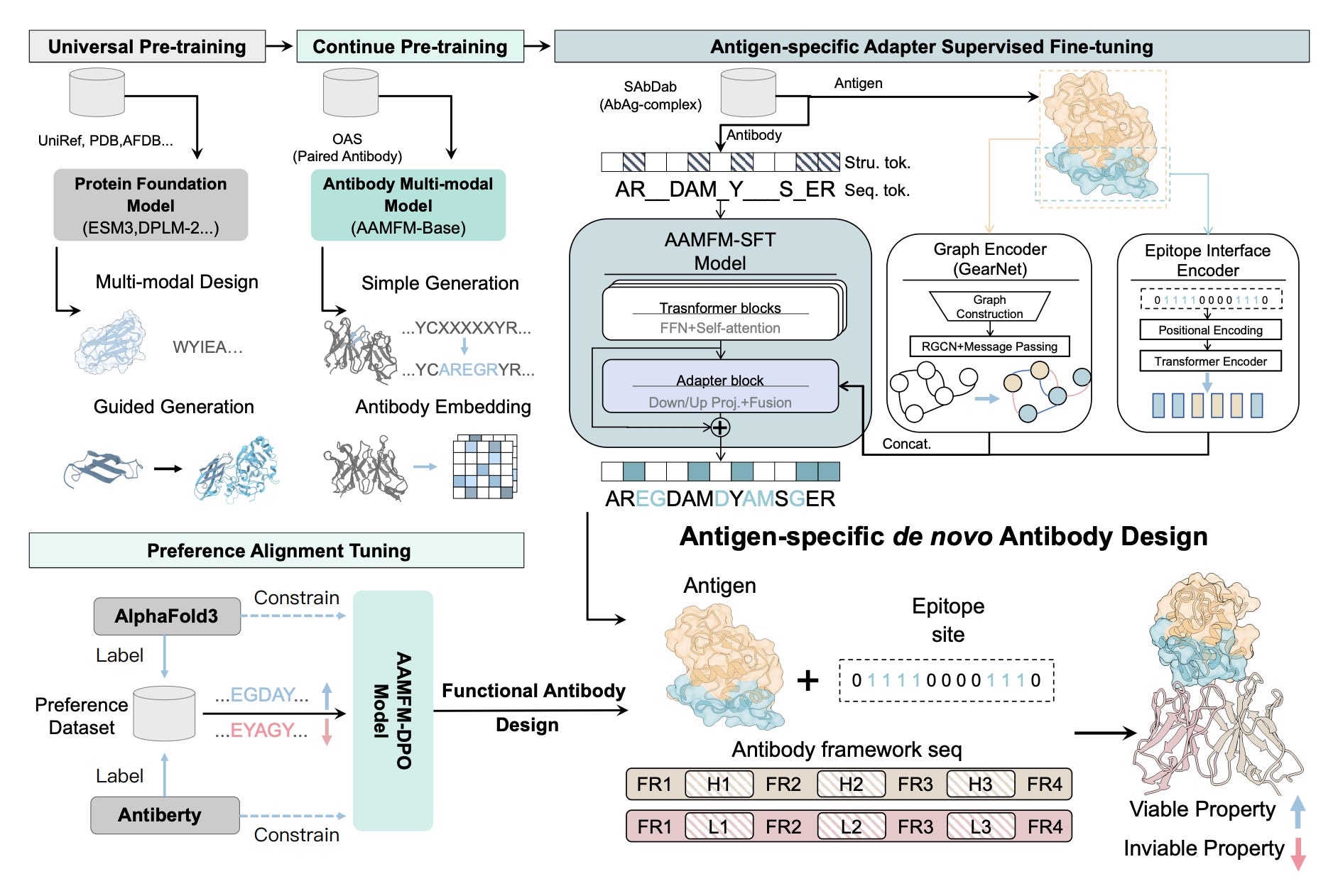
Xiaoliang Shi, Zichen Wang, Runze Ma, Zhongyue Zhang, and Shuangjia Zheng built AAMFM as a three-stage system on top of ESM3. First, continual pretraining on antibody structures. Second, supervised fine-tuning for CDR design conditioned on the antigen via a GearNet adapter that injects antigen geometric features. Third, alignment with Calibrated Direct Preference Optimisation (Cal-DPO) using structural priors as preference signals so that the model learns to favour designs with better predicted binding geometry.
The evaluation uses RMSD, amino acid recovery, paratope hit rate, and pseudo log-likelihood (via AntiBERTy). The authors report state-of-the-art performance on functional antibody design benchmarks, though the preprint does not include experimental validation of designed sequences.
Why This Is Cool
The Cal-DPO stage is the methodologically interesting part. DPO has been used extensively in language model alignment but applying it to protein design with structural priors as the preference signal is relatively new. The idea is that instead of just maximising sequence recovery against known antibodies, you can rank candidate designs by their predicted structural compatibility with the target and use those rankings as training signal. Whether this translates to better binders in practice is still unproven since there is no wet-lab validation here. Worth following if they publish binding data.
Read the paper.
Try the code.
High-throughput machine learning-aided antibody discovery for cell surface antigens
Where This Fits
ML-based antibody design gets a lot of attention, but most computational approaches still depend on training data that does not exist for many targets. You need paired antibody-antigen binding data at scale, and for most antigens that data is sparse or proprietary. This paper from the Meijers and Marks labs takes a different angle: instead of training better generative models on limited data, build a synthetic library that is explicitly designed to be ML-compatible from the start, screen it experimentally against many targets at once, and release the whole dataset publicly.
What It Is
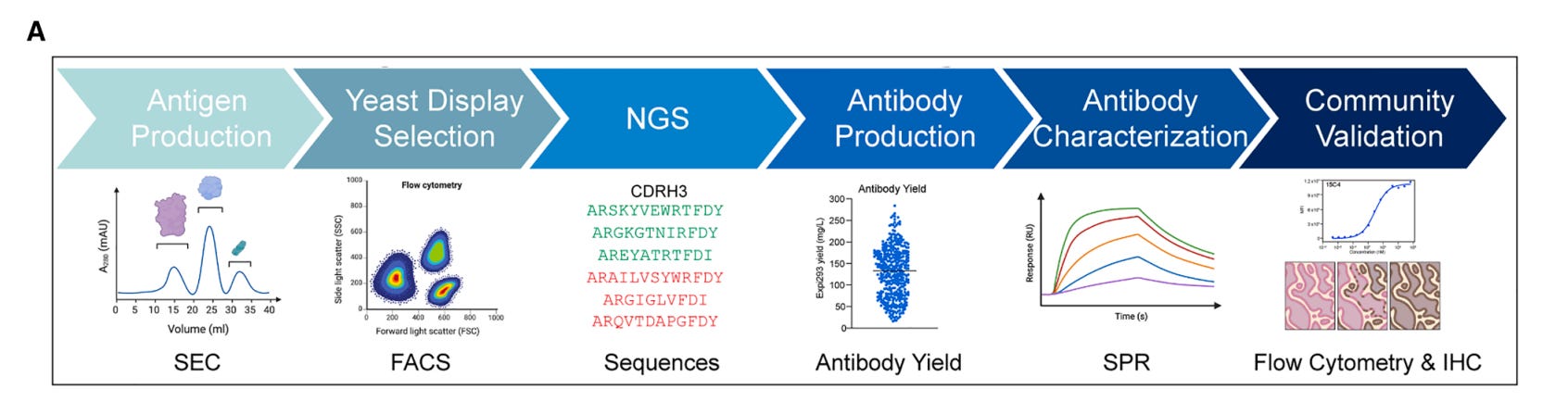
Deepash Kothiwal, Aaron Kollasch, Timothy Springer, Debora Marks, Rob Meijers, and a large team across the Institute for Protein Innovation, Harvard, and the Broad Institute built a minimal synthetic Fab yeast display library. The library encodes diversity in the CDRH3 loop within a compact antigen recognition module (ARM) of fewer than 100 nucleotides, using position-specific amino acid frequencies derived from 9.5 million CDRH3 sequences in the Observed Antibody Space database. Estimated diversity: roughly one billion unique clones.
They screened this against ten cell surface glycoproteins in parallel, including PD-L1, PD-L2, TIGIT, ROBO1, ROBO2, DKK1, LOX1, DCC, IL-23R, and syncytin-2. The campaign yielded 424 antibodies with sufficient production, 301 passing aggregation and polyreactivity filters, 103 with K_D below 10 nM by SPR, and 118 with EC50 below 25 nM by cell-based assay. Then they applied logistic regression to the deep sequencing data from PD-L2 and ROBO2 selections and identified additional low-frequency binders that the experimental FACS sorting had missed.
Why This Is Cool
The library design is deliberately minimal so that all diversity lives in one short, sequenceable region. That makes the entire dataset immediately usable for ML: you get a compact sequence representation linked to experimental binding outcomes across multiple targets, with no ambiguity about which residues drive recognition. The public release of this data is probably more valuable than any single antibody it produced. Most groups training antibody ML models are data-limited. This gives them a clean, multi-target training set with negative examples built in. The logistic regression rescue of missed binders is also a nice proof-of-concept that even simple ML can add value on top of experimental selection when the data is structured correctly.
Read the paper.
🗓️ Events & Competitions
The best competitions, hackathons, and community challenges in AI x life sciences, curated weekly. Know something worth featuring? Reply and let us know.
More upcoming events:
BioHackathon Europe 2026 | November 9-13, Barcelona
ELIXIR’s annual international bioinformatics hackathon, running since 2018. 160+ participants, five days of collaborative coding on open bioinformatics infrastructure and tools. The call for project proposals has now closed.
Thanks for reading!
💬 Get involved
We’re always looking to grow our community. If you’d like to get involved, contribute ideas or share something you’re building, fill out this form or reach out to me directly.
Connect With Us
Have questions or suggestions? We'd love to hear from you!
📧 Email Us | 📲 Follow on LinkedIn | 🌐 Visit Our Website