

Welcome back to your weekly dose of AI news for Life Science! This weeks fix:
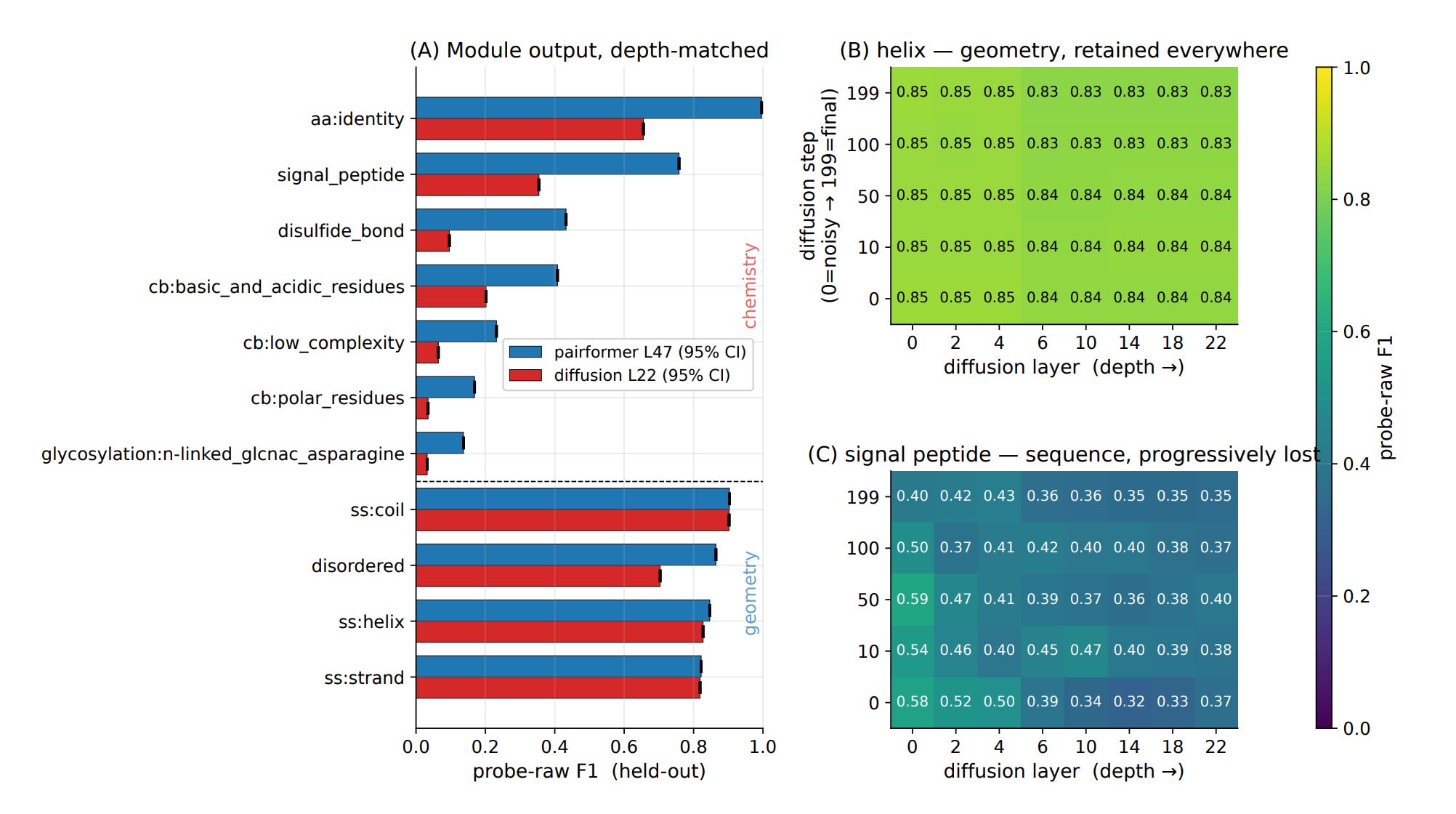
A group cracked open Boltz-1 with sparse autoencoders and found something odd: a probe can decode beta-strand identity with F1=0.82 from the trunk representations, but steering on that same direction produces zero structural change in the output.
NVIDIA trained a genomic foundation model that predicts functional embeddings of masked segments rather than reconstructing nucleotides, and it hit state-of-the-art on 17 benchmarks regardless of which underlying architecture they plugged it into.
Flow cytometry finally got a foundation model, and it solves the problem that has blocked transfer learning in the field for years: every lab uses different antibody panels.
You read this newsletter because staying current in AI x life science matters to you, it matters to us too. That's why we're building a free personalised resource for the community: from papers, patents, and clinical trials to c-suite career moves and job opportunities. So you can stay up to date with what actually matters to you.
We want to know: where else are you looking? What's missing? Two minutes of your time will shape what gets built.
Probing and Steering Biology across Boltz-1’s Trunk-Diffusion Boundary
Where This Fits
Mechanistic interpretability has been productive in language models. People have found features for sentiment, syntax, factual knowledge, and steered model outputs by activating them. Nobody has done this seriously for protein structure predictors, which is strange given how much we are now betting on Boltz, AlphaFold3, and their derivatives. Piotr Jedryszek, Oliver Crook, and colleagues took the tools of mechanistic interpretability (linear probes, sparse autoencoders, causal interventions) and pointed them at Boltz-1‘s internal representations, specifically at the boundary between the Pairformer trunk and the diffusion module that actually generates coordinates
What It Is
They found that both geometry and sequence chemistry are linearly decodable from the trunk. Secondary structure information transfers essentially unchanged into the diffusion module. Sequence chemistry attenuates sharply. When they intervened on helix and coil directions, the diffusion module responded dose-dependently: push the representation toward “helix” and you get more helical output. Clean causal control.
Then the surprise. Beta-strand prediction from the trunk hits F1=0.82. Highly decodable. They steered on it. Nothing happened. No measurable structural change in the output. A direction can be perfectly readable by a linear probe and causally inert for generation.
Why This Is Cool
This matters beyond Boltz-1. The entire field of controllable protein generation assumes that if you can find where information lives in a model’s representations, you can manipulate it to steer outputs. This paper shows that assumption is wrong in at least one important case. Decodability is necessary for steering but not sufficient. The model can represent something clearly without using that representation causally downstream.
For anyone building conditional protein generators or trying to control fold topology through latent manipulation, the implication is uncomfortable: you need causal validation, not just probing accuracy, before claiming you can steer anything. The authors released all trained SAEs, per-residue activations, and analysis code under CC BY 4.0, so others can replicate and extend this on different structure predictors.
JEPA-DNA: Grounding genomic foundation models through joint-embedding prediction
Why This Is Cool
Every genomic foundation model I am aware of learns the same way: mask some tokens, predict them back. Masked language modelling for DNABERT-2. Next-token prediction for HyenaDNA. The assumption is that reconstructing nucleotide sequences teaches functional understanding. It is the same bet NLP made with BERT, and it works reasonably well. JEPA-DNA from Ariel Larey, Elay Dahan, and colleagues at NVIDIA Digital Biology asks: what if you skip token reconstruction entirely and predict functional representations instead?
What It Is
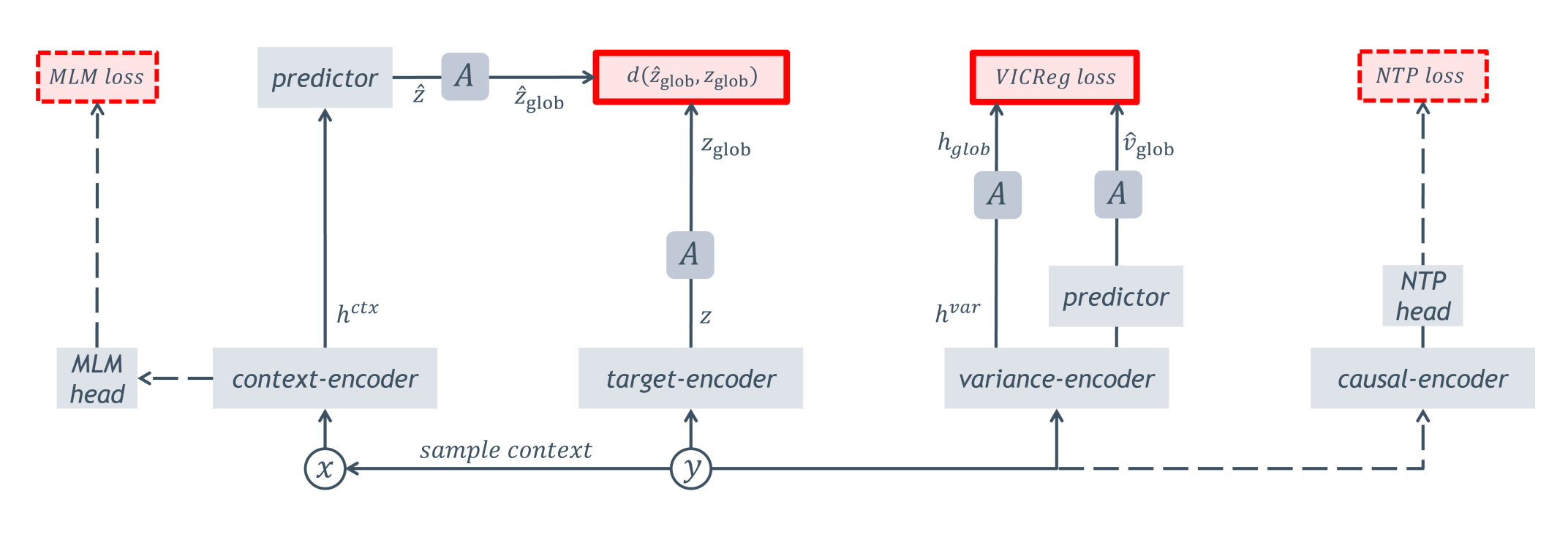
JEPA-DNA applies joint-embedding predictive architecture to genomics. Rather than recovering masked nucleotides, the model predicts the latent embedding of the masked segment, supervised to align with a functional target representation in shared latent space. The idea is borrowed from Yann LeCun’s JEPA framework for vision: predict what something means, not what it looks like. They combine this with a standard generative objective during continual pretraining, so the model retains local syntax while gaining higher-level functional grounding.
The clever part: the approach is architecture-agnostic. They plug it into DNABERT-2, Nucleotide Transformer v3 (8M and 100M), HyenaDNA, and Caduceus, and all of them improve. State-of-the-art across 17 genomic benchmark tasks in both linear probing and zero-shot settings. The gains hold regardless of model size or architecture family.
Where This Fits
Genomic foundation models have been stuck in an awkward position. They are good at local motif recognition, decent at variant effect prediction, and mediocre at anything requiring long-range functional understanding. The standard explanation is “we need more data” or “we need longer context.” JEPA-DNA suggests the training objective itself is the bottleneck, not scale. If predicting functional embeddings consistently improves every architecture you try it on, that is an objective-level insight, not a model-level one.
Code and pretrained checkpoints are on GitHub and HuggingFace.
CytoBERT: A foundation model for cytometry data
What It Is
Syed Abdul Haseeb Qadri, Martin Becker, and colleagues at the University of Rostock built a BERT-style foundation model pretrained on over 50 million cells from 15 heterogeneous cytometry datasets. The model is open-source and open-weight.
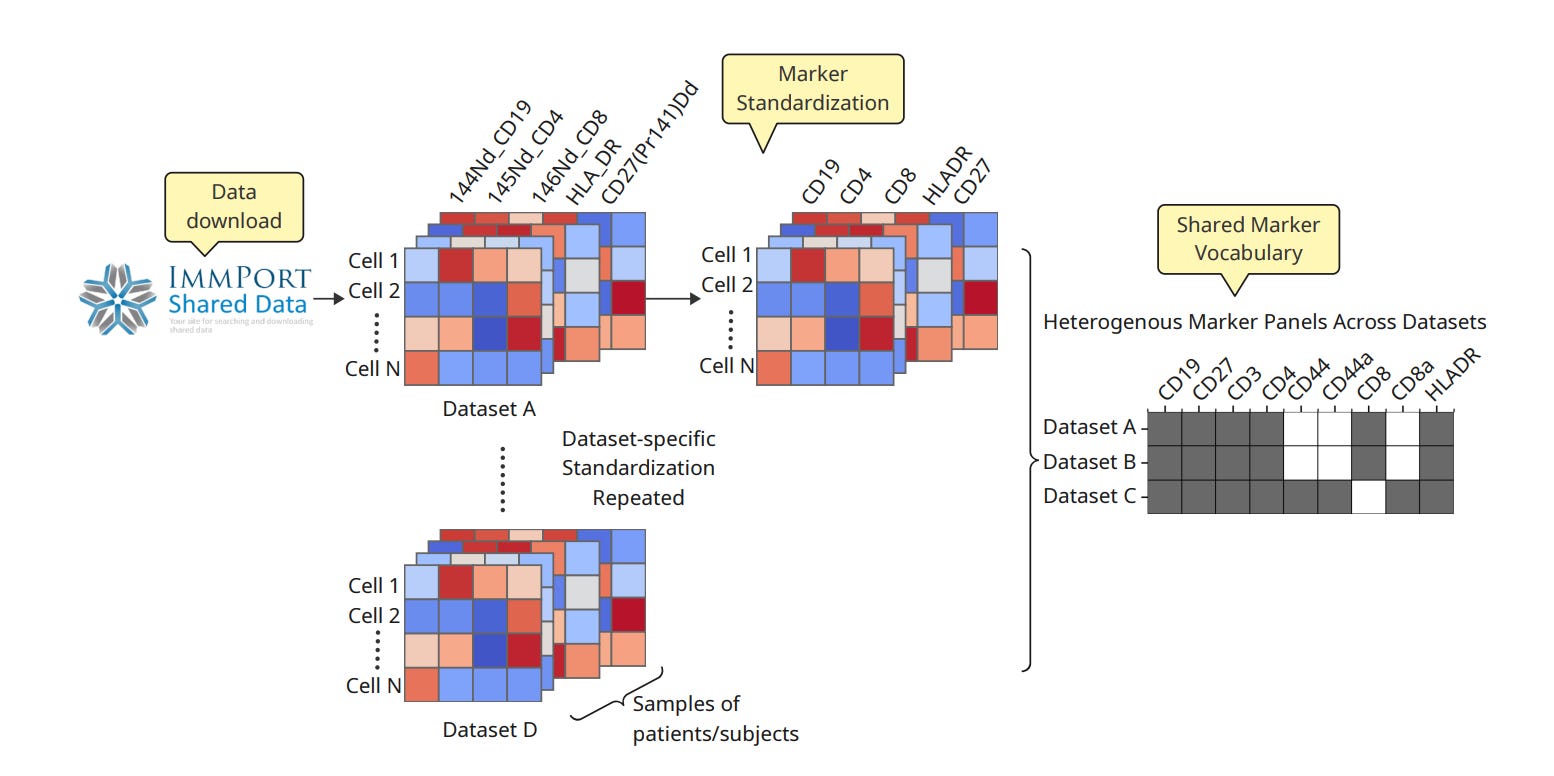
The specific problem CytoBERT solves: every cytometry experiment uses a different antibody panel. A T-cell immunophenotyping study might measure CD3, CD4, CD8, CD45RA, CCR7. A myeloid panel measures CD14, CD16, HLA-DR, CD11c. There is almost no overlap. Traditional transfer learning cannot work because the input features change between experiments. CytoBERT handles this through marker standardisation during corpus curation, learning transferable inter-marker relationships that generalise across panel configurations.
Where This Fits
Single-cell foundation models are everywhere now. scGPT, Geneformer, scBERT, the list goes on. All of them work on transcriptomics. Cytometry, which is arguably more clinically deployed (every haematology lab runs flow), has been left behind because the variable-panel problem makes it architecturally harder. You cannot treat markers as a fixed vocabulary the way you treat genes. CytoBERT is the first open model to tackle this directly at foundation-model scale.
Why This Is Cool
The clinical angle is what makes this interesting to me. Flow cytometry is used daily for leukaemia diagnosis, HIV monitoring, transplant rejection assessment. These are settings where a pretrained model that transfers across institutions and panel designs could reduce the manual gating burden substantially. Whether CytoBERT’s transfer learning actually works well enough for clinical-grade classification remains to be shown in follow-up work, but the proof of concept, that you can pretrain meaningfully across heterogeneous cytometry panels, removes the main objection people had to attempting this at all.
🗓️ Events & Competitions
The best competitions, hackathons, and community challenges in AI x life sciences, curated weekly. Know something worth featuring? Reply and let us know.
More upcoming events:
BioHackathon Europe 2026 | November 9-13, Barcelona
ELIXIR’s annual international bioinformatics hackathon, running since 2018. 160+ participants, five days of collaborative coding on open bioinformatics infrastructure and tools. The call for project proposals has now closed.
Thanks for reading!
💬 Get involved
We’re always looking to grow our community. If you’d like to get involved, contribute ideas or share something you’re building, fill out this form or reach out to me directly.
Connect With Us
Have questions or suggestions? We'd love to hear from you!
📧 Email Us | 📲 Follow on LinkedIn | 🌐 Visit Our Website