
Scigantic: The Platform That Democratizes Access to Large-Scale Data
Deep Dive | Edition 21

Welcome back to the deep dive, where we break down the AI tools and data reshaping how new drugs are discovered. In each edition, we speak directly with the teams behind these tools to explain what they solve, how they work and where they are going next.
Open scientific data has an access problem, and a former Terra engineer is building the fix
For computational biologists, genomics researchers, and any scientist working with large open-source datasets they can’t actually use.
Open data mandates have flooded repositories with petabytes of publicly available scientific data. In practice, most academic researchers can’t touch it. Downloading costs thousands in egress fees, requires cloud infrastructure they don’t have, and takes weeks of setup before a single analysis runs.
Scigantic puts compute where the data already lives. Nearly 1 exabyte of open-source data appears as local files in a notebook, with zero transfer fees and built-in fine-tuning for foundation models like ESM and DNABERT. It was built by someone who spent years on Terra at the Broad Institute and saw exactly where enterprise genomics platforms fail the people who need them most.
This piece covers what the platform does, why the person behind it is unusually well-positioned to build it, and what it means for the growing gap between “data exists” and “researchers can work with it.”
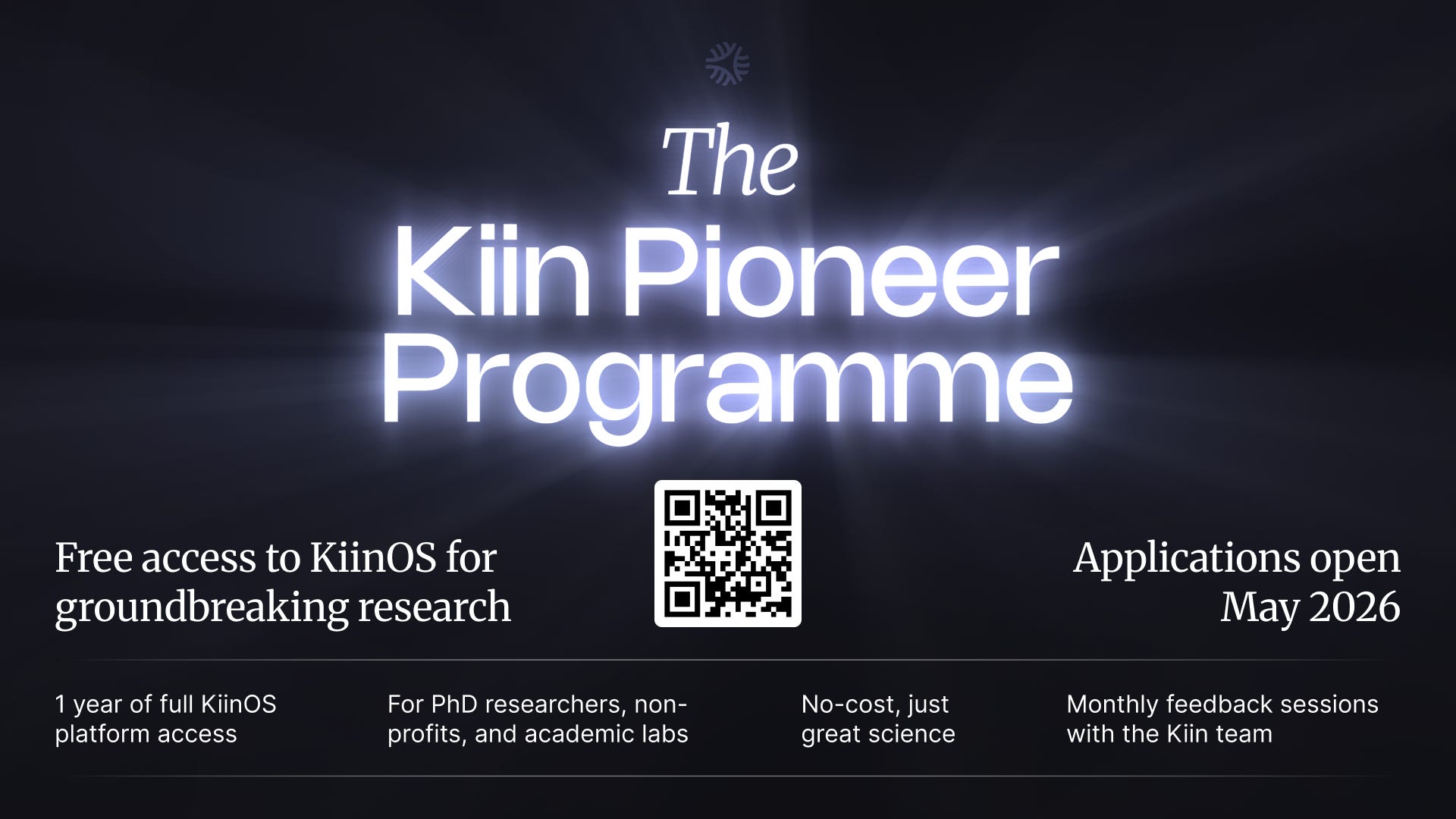
Kiin Pioneer Programme
We built a platform that helps researchers speed up their entire science, from literature review and biomarker discovery to bioinformatics and computational chemistry. If your workflow involves pulling findings from five different places before you can actually act on any of them, this is for that.
The Pioneer Programme gives academic labs and non-profits one year of free access, plus support from our science team. No cost, no data transfer, all IP stays with your institution. Applications close August, cohort starts September.
This week we spoke with Aaron Kanzer, founder of Scigantic, a platform that lets scientists work with massive open-source datasets without ever downloading them. Aaron is a solo founder running the company out of Boston, fully bootstrapped, with no outside funding. Before Scigantic he was a senior engineer at the Broad Institute working on Terra (the genomics platform serving 65,000 users across 80 petabytes of data), a founding engineer on MIT’s LINC project mapping neural circuits, and most recently scaled ML operations at Generate:Biomedicines. He built Scigantic because he kept watching the same problem go unsolved from the inside.
The problem: open data that isn’t actually open
There is a quiet fiction in science right now. Funders mandate open data sharing. Repositories grow by petabytes each year. Papers cite datasets that are technically available to anyone. The word “open” appears in every grant report.
The reality for a postdoc with a laptop and no cloud budget is different. “Open” means the data exists on a server somewhere. To actually use it, you need to download terabytes over days or weeks, pay egress fees that can run into thousands of dollars per transfer, set up cloud infrastructure you were never trained to manage, and hope your local machine has the storage to hold it all. Most don’t.
The origin was personal. At MIT’s McGovern Institute, Aaron was working on the LINC project, mapping neural circuits through high-resolution brain imaging. “I noticed that these amazing datasets were being generated within the LINC project,” he told us. “Incredible high-resolution images of the brain with a ‘wow’ factor. However, the data engineering necessary to access these images was so technical and challenging.” The data existed. It was extraordinary. And almost nobody outside a small group of engineers could actually get to it. “How might we improve this process for anyone in the scientific community?” That question became Scigantic.
The problem compounds with AI models. Tools like ESM and OpenFold are open-source, technically free to use. In practice, fine-tuning them on your own data requires weeks of infrastructure setup, or you go back to the original team and ask them to run it for you. The models are open. The ability to actually use them is not.
As Kanzer puts it: “Open-source models are great as a base case for scientific discovery. If you have a more targeted hypothesis, or a specific therapeutic you are developing, fine-tuning becomes integral. Setting up fine-tuning though still has a steep data engineering learning curve before you can conduct any science.” The bottleneck is not the model. It is everything between the model and actually using it on your own data.
For context: AWS charges between $0.09 and $0.12 per gigabyte for data transfer out of S3. A single copy of the AlphaFold database is over 20 terabytes. That is roughly $2,000 just to download one dataset, before you’ve done a single calculation. Multiply that across the dozens of datasets a real project might touch, and “open” starts to feel like a word with a hidden paywall attached.
The approach: compute moves to the data
Scigantic inverts the model. Instead of moving data to the researcher, it moves the researcher’s compute to where the data already lives. You open a JupyterHub notebook. The datasets you need appear as local files on your machine. You write code as if everything is sitting on your hard drive. Nothing ever downloads.
The mechanism is elegant: FUSE mounts make cloud-hosted data appear as a local filesystem. Every file read translates to a range-GET against the object store, pulling only the bytes you actually need. Your analysis runs in the same cloud region as the data. When you’re done, only the results leave: a trained model, a table, a figure. Typically megabytes, not terabytes.
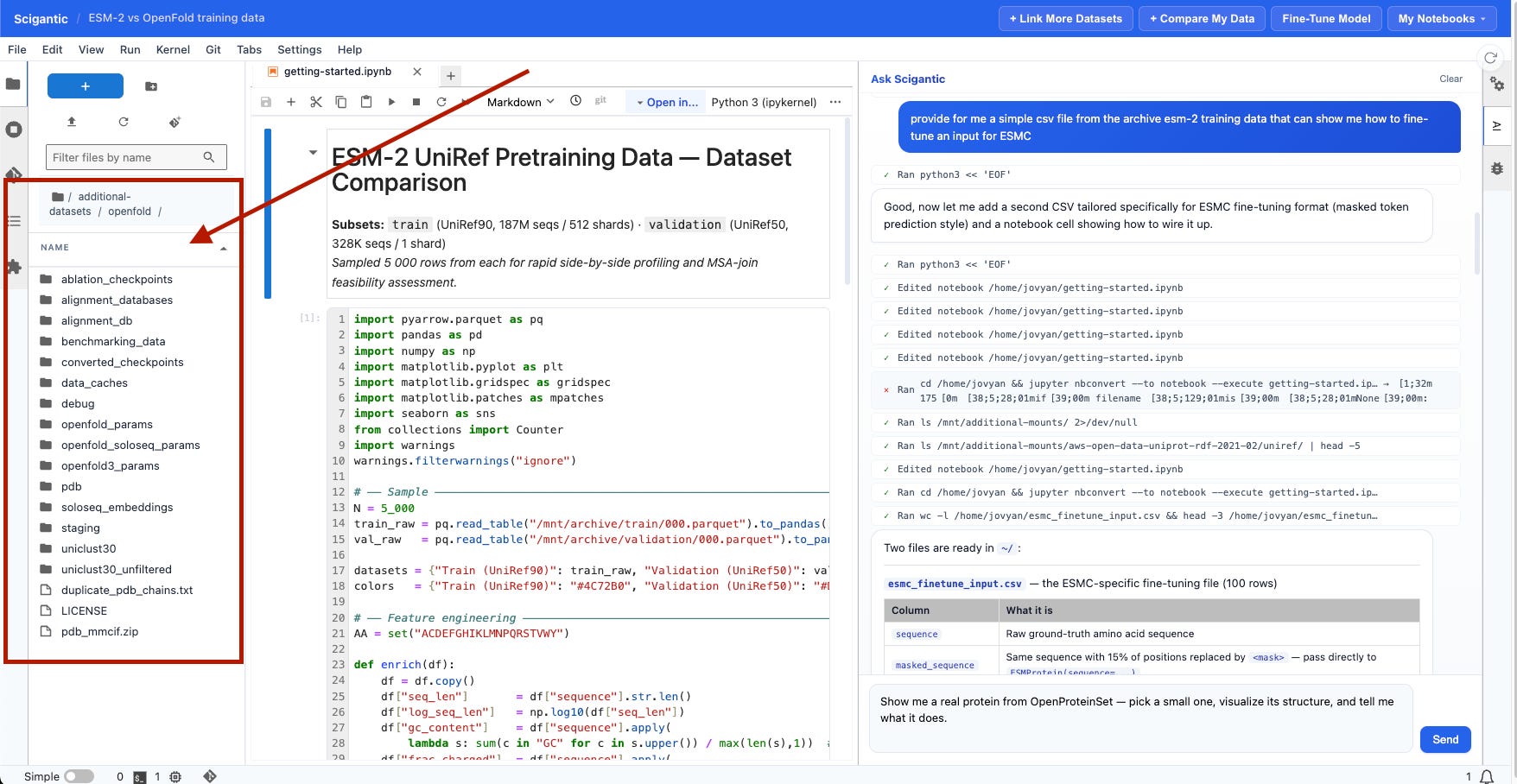
Kanzer’s analogy is a library. “Rather than taking the entire book off the shelf, instead hand me the specific page I’m looking for. No one is reading the entire book, so why move the entire book?” That is what FUSE mounts achieve under the hood. The data stays in the cloud. Your notebook reads only the bytes it needs, as if they were sitting on a local drive. “FUSE is great because it elegantly tricks the agent into operating as if the data is a local directory,” Kanzer says. “It’s a more clever mousetrap when dealing with large-scale datasets.”
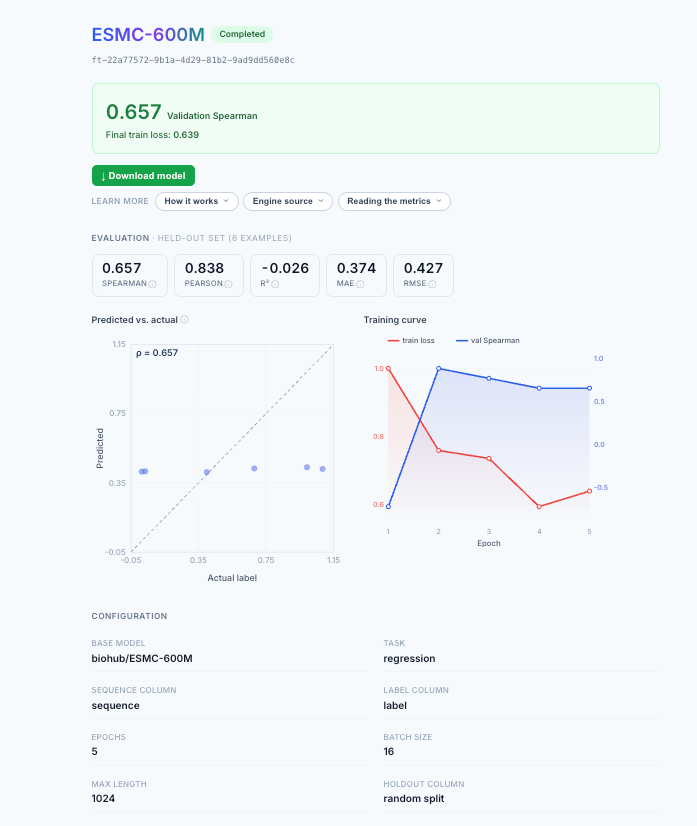
For fine-tuning, the workflow is similarly stripped back. Upload a CSV of sequences and labels, pick a foundation model, train. LoRA on frozen backbones means the whole thing fits on 24-48 GB cards. No training loops to write. No dependency management. No fighting with CUDA versions at 2am.
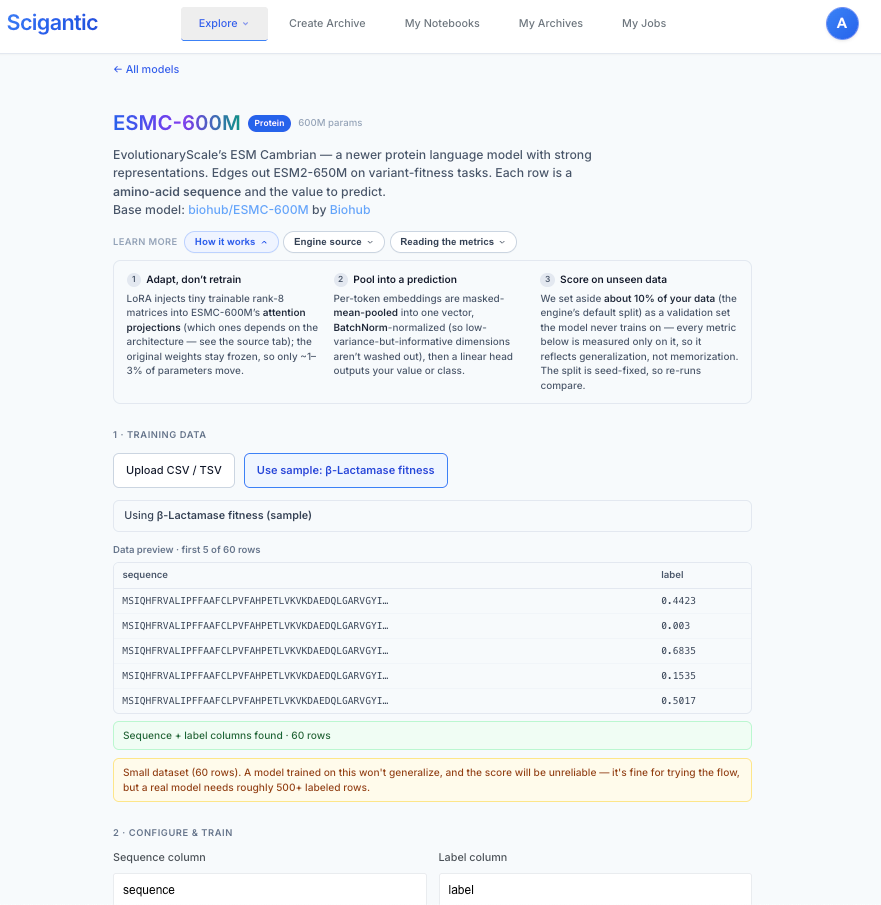
The platform currently links nearly 1 exabyte of open-source data spanning structural biology, genomics, neuroscience, and climate science. Datasets include UniProt, the full TCGA cancer genomics archive, CZ CELLxGENE Census, Allen Brain Atlas, and dozens more.
Why it’s different: built by the person who saw the limits from the inside
What makes this more than another cloud notebook is who built it and why. Aaron spent time working on Terra at the Broad Institute, the largest open-source genomics platform in the world. He knows exactly what works about that system and exactly where it breaks down for the people who need it most. Terra is powerful, complex, enterprise-focused, and genomics-specific. If you’re a neuroscientist or a climate researcher, it doesn’t serve you. If you’re a postdoc without a bioinformatics team behind you, the learning curve alone can take weeks.
“Terra is an amazing tool for researchers, but I felt it was tightly coupled to specific genomic hypotheses,” Kanzer says. “Exploratory data analysis and fine-tuning require flexibility, so Scigantic is trying to abstract data engineering and ultimately let the researcher decide.” The distinction matters. Terra serves genomics well. If you are a neuroscientist, a climate scientist, or simply someone who wants to explore data before committing to a hypothesis, it was not built for you. “Data-scaling issues are not isolated to genomics or life sciences,” Kanzer adds. “They occur in all forms of science.”
One example of what “differently” looks like in practice: comparing ESM predictions against OpenFold outputs. Today, that means two separate environments, two sets of dependencies, two data pipelines. On Scigantic, it’s one notebook session. Both models, same data, side by side.
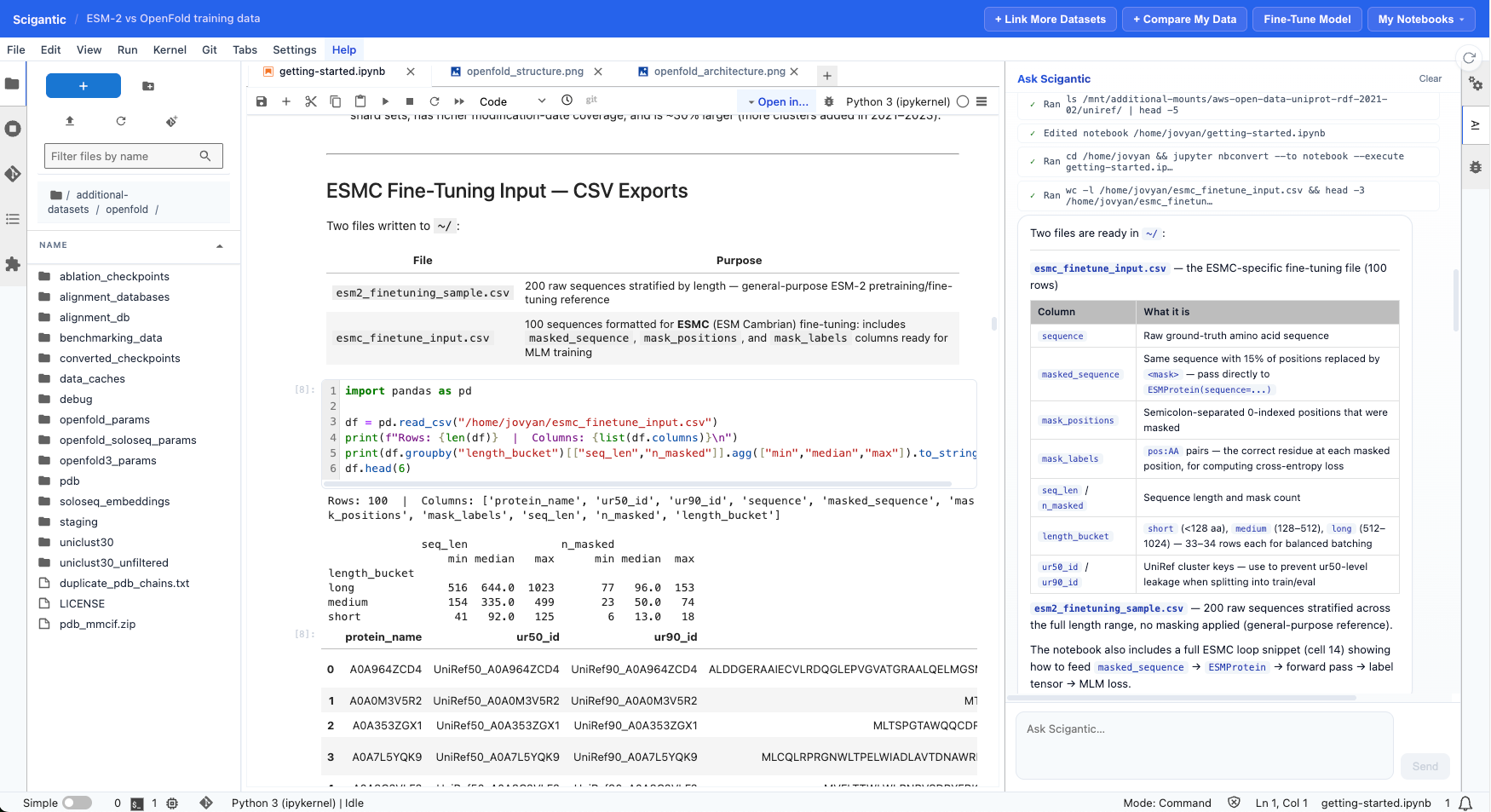
The platform also includes an AI assistant built into JupyterLab that has context on every mounted dataset’s schema. It can point you toward relevant columns, suggest analyses, or nudge you back if you’re heading in an unproductive direction. It is not a chatbot bolted onto a product. It knows what data you’re looking at.
Who it’s for
Scigantic is built for academics first. Postdocs, PhD students, researchers at institutions that don’t have dedicated cloud engineering teams (which is most of them). The pricing reflects that: a free tier exists, and the researcher plan is $19 per month.
The logic is deliberate, not a limitation. “The most impactful scientific breakthroughs originate in academia before being commercialised,” Kanzer says. “The Human Genome Project. The Protein Data Bank. Scigantic believes that prioritising academics first will lead to a much larger impact later on.” Today’s postdoc running analyses on the free tier is tomorrow’s head of computational biology choosing infrastructure for an entire department.
Early feedback suggests the platform points researchers in productive directions faster than existing tools. The AI assistant in particular seems to help people who know what question they want to ask, but don’t know which dataset or which column holds the answer.
Early signs suggest it is working. One MIT postdoc put it directly: “Scigantic’s ability to quickly navigate large S3 buckets is incredibly valuable. Gemini, Claude, Codex, etc. try to download large datasets in real-time, often never getting a solid answer to my question. I’m thoroughly impressed how fast it gets me onboarded to the data.” The bar here is not perfection. It is whether the platform gets a researcher to a productive starting point faster than the alternatives. By that measure, it seems to be landing.
The future
Aaron has started conversations with multiple renown research institutions. He’s exploring what a partnership with Kiin could look like. The vision is to become the default access layer between open scientific data and the researchers who need it, across every domain, not just genomics.
“We see multiple partnerships forming with Scigantic in the next year, further validating our hypothesis that navigating unstructured, large-scale data is the bottleneck,” Kanzer says. NASA conversations are already underway. The thesis is simple: if the bottleneck is access, and access keeps getting harder as datasets grow, then the platform that solves it once becomes the default layer everyone builds on.
The fact that this is bootstrapped and solo matters. There’s no board pushing toward enterprise sales or premature monetisation. The roadmap can stay focused on what academics actually need, for now. That is a strategic choice, not a limitation.

Kiin’s view
The “why now” here is straightforward. Open data mandates from NIH, Wellcome, and the EU are flooding repositories with petabytes of new data every year. Foundation models for biology are proliferating faster than any lab can keep up. The gap between “data exists” and “I can work with it” is widening, not closing. Someone was going to build this access layer. The fact that it’s being built by someone who spent years inside Terra, who understands both the infrastructure and the user pain at a level most founders don’t, is what makes it credible.
The risk is execution at scale with a single person. The opportunity is that the product is simple enough in concept (notebook + mounted data + fine-tuning) that it doesn’t need a 50-person engineering team to work. It needs to work reliably for the 10,000 postdocs who currently can’t access the data their own field generated. If it does that, the enterprise customers will follow.
Thanks for reading Kiin Bio Weekly!
💬 Get involved
We’re always looking to grow our community. If you’d like to get involved, contribute ideas or share something you’re building, fill out this form or reach out to me directly.
Subscribe now to stay at the forefront of AI in Life Science and keep up with this upcoming season of deep dives.
Connect With Us
Have questions on this or suggestions for our next deep dive? We’d love to hear from you!
📧 Email Us | 📲 Follow on LinkedIn | 🌐 Visit Our Website