
Stanford's scVision, Ohio State's conDitar-dev, and the AllTheBacteria consortium
Kiin Bio's Weekly Insights

Welcome back to your weekly dose of AI news for Life Science! This weeks fix:
scVision throws out the tokenisation paradigm for single-cell models entirely and represents cells as images instead. The results are surprisingly strong.
conDitar-dev does something rare in generative drug design: it goes to the bench. Real synthesis, real binding assays, real selectivity data.
AllTheBacteria is less a paper and more a piece of infrastructure. 2.4 million bacterial genomes, uniformly processed, with a proof-of-concept antibiotic discovered from querying it.
Kiin Pioneer Programme
We built a platform that helps researchers speed up their entire science, from literature review and biomarker discovery to bioinformatics and computational chemistry. If your workflow involves pulling findings from five different places before you can actually act on any of them, this is for that.
The Pioneer Programme gives academic labs and non-profits one year of free access, plus support from our science team. No cost, no data transfer, all IP stays with your institution. Applications close August, cohort starts September.
scVision: A vision foundation model for single-cell biology
Where This Fits
Everyone building single-cell foundation models has been pretty much following the same NLP playbook since 2023: treat genes as tokens, cells as sentences and train a transformer. scGPT, Geneformer, scFoundation all do this. It works reasonably well for cell-type annotation, but the tokenisation step is where information is lost. You have to bin continuous expression values into discrete categories, and then you throw away co-expression structure entirely. There have been several independent evaluations over the past year questioning whether these models actually beat simpler baselines once you control for dataset size. scVision does something different: it asks whether vision, not language, is the right modality for this data.
What It Is
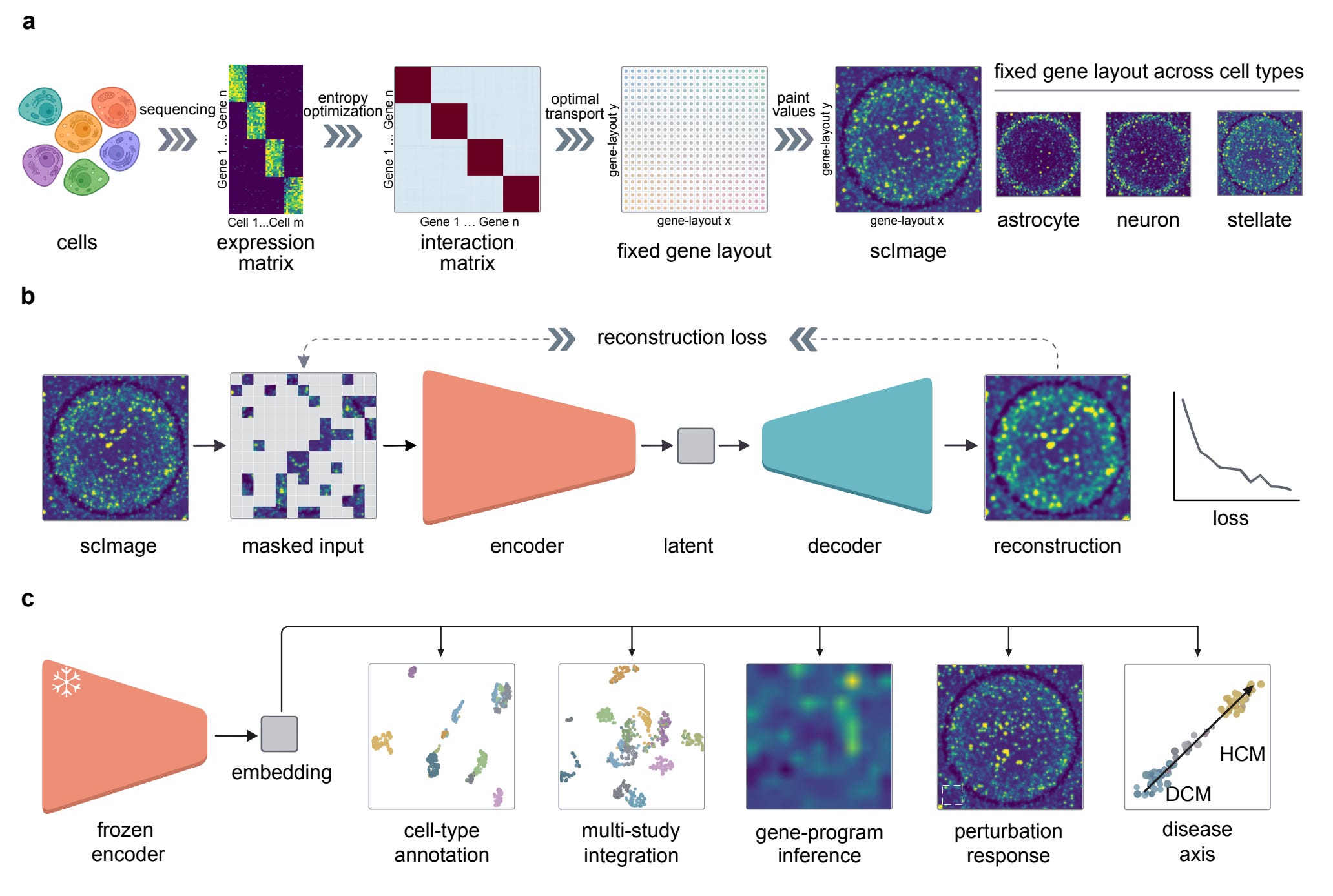
Ridvan Yesiloglu, Md Tauhidul Islam, and colleagues at Stanford represent each cell’s transcriptome as a 2D image. Genes get placed on a 104x104 grid using Gromov-Wasserstein optimal transport so that co-regulated genes end up as spatial neighbours. This layout is shared across all cells, which means attention patterns in the model map directly onto gene programmes without any post-hoc interpretability analysis.
The model is an 86M-parameter Vision Transformer pretrained with masked image modelling on 72 million human cells. In zero-shot cell-type annotation across six held-out tissues it ranked first on every atlas, balanced accuracy 0.47 to 0.83 depending on the tissue. The few-shot results are arguably more impressive: one labelled cell per type with scVision matched the performance of 50 labelled cells with the competing models.
Why This Is Cool
The benchmark numbers are strong but annotation is the easiest downstream task, so I would not get too excited about those alone. What is more interesting is what the representation enables. Because genes are spatially arranged by co-expression, you can do things like mask a neighbourhood of genes and ask what the model predicts, or run perturbation experiments on patches of co-regulated genes, or read attention maps as pathway activations. None of those operations have analogues in the token-based models. Whether this actually helps with harder tasks like perturbation prediction or drug response is still an open question. Worth watching.
Read the paper.
Try the demo.
conDitar-dev: Generating developable 3D molecules via pocket-conditioned diffusion
Where This Fits
There are now a lot of diffusion-based methods for structure-based drug design: TargetDiff, Pocket2Mol, DiffSBDD, and others. They generate molecules conditioned on a protein binding pocket and they generally optimise for binding affinity. The well-known problem is that affinity alone does not make a drug. The molecules these tools produce tend to have poor solubility, metabolic instability, or toxicity flags, and medicinal chemists end up spending months fixing properties by hand. conDitar-dev tries to fix this at the source by incorporating developability constraints directly into the generation process rather than treating it as a downstream optimisation.
What It Is
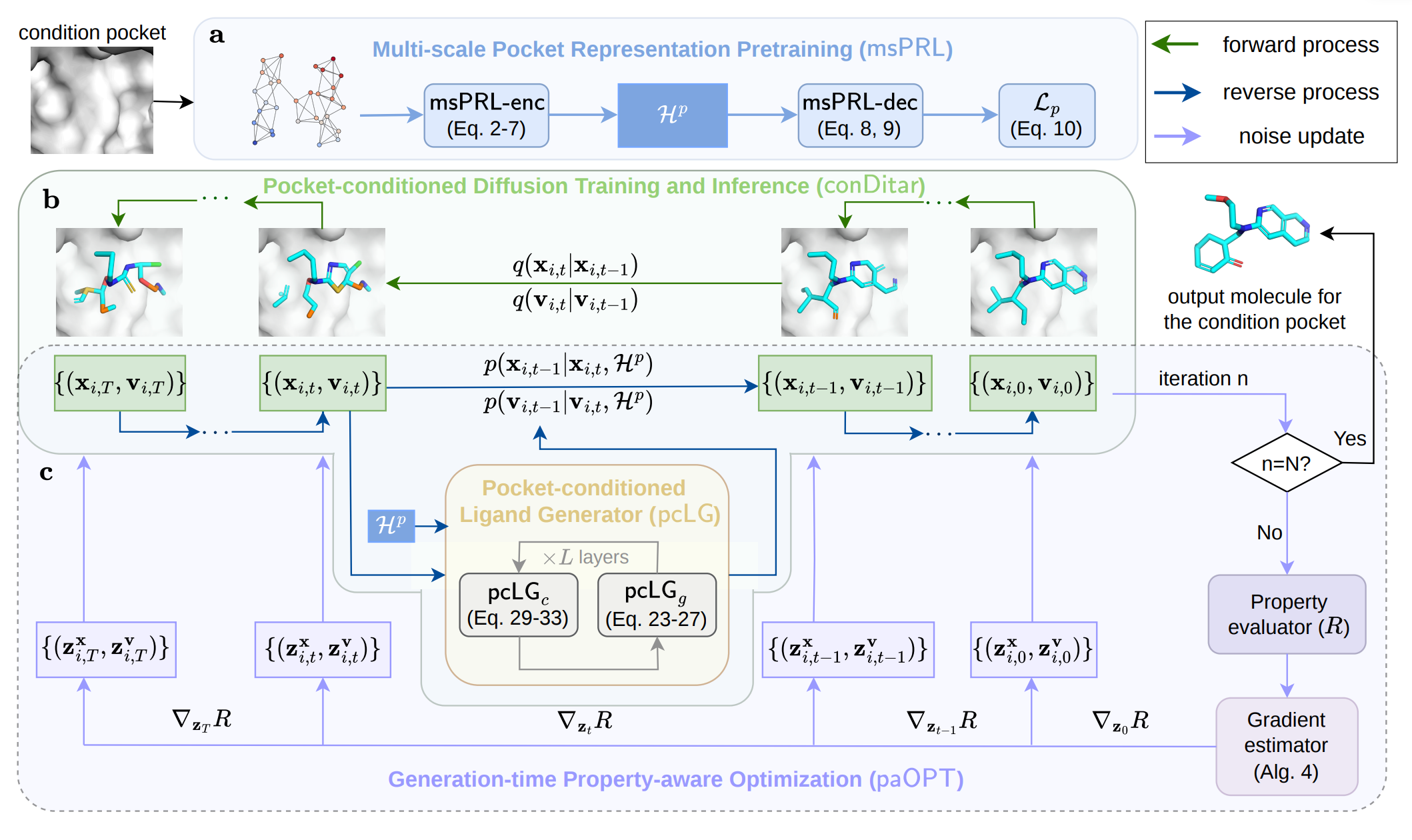
Ruoxi Gao, Xia Ning, and collaborators at Ohio State, the University of Minnesota, Google, and Sanofi built a three-module framework. A pretrained pocket encoder (msPRL) learns multi-scale binding site representations. A diffusion model (conDitar) generates 3D ligands conditioned on those. A plug-and-play optimiser (paOPT) steers the diffusion trajectory toward better ADMET properties at generation time, no retraining required.
On their new human-targets-only benchmark (CDH, 84 disease-relevant proteins), conDitar achieves average Vina D scores of -8.85 kcal/mol, 7.4% better than the next baseline. Adding paOPT improves ADMET properties by up to 73% while maintaining comparable affinity. The CDH benchmark itself is a useful contribution since CrossDocked2020 mixes in non-human targets which confounds therapeutic relevance.
The part that stands out: they synthesised compounds and tested them. Two conDitar-dev molecules for PD-L1 showed SPR-derived K_D values of 3.49 and 3.75 micromolar. For CSF1R, hit expansion on conDitar-dev designs identified selective inhibitors with IC50 as low as 200 nM and promiscuity hit rates under 2.5%.
Why This Is Cool
Most generative drug design papers stop at computed docking scores. This one went to the bench, which immediately puts it in different territory. Whether micromolar PD-L1 binders are interesting enough to advance is debatable, but the workflow producing testable, druglike matter on the first pass is the point. The paOPT module being training-free and pluggable is also notable since ADMET requirements change between programmes and you do not want to retrain your generative model every time the target product profile shifts.
Read the paper.
Try the code.
AllTheBacteria: A community resource for bacterial genomics and antimicrobial discovery
Where This Fits
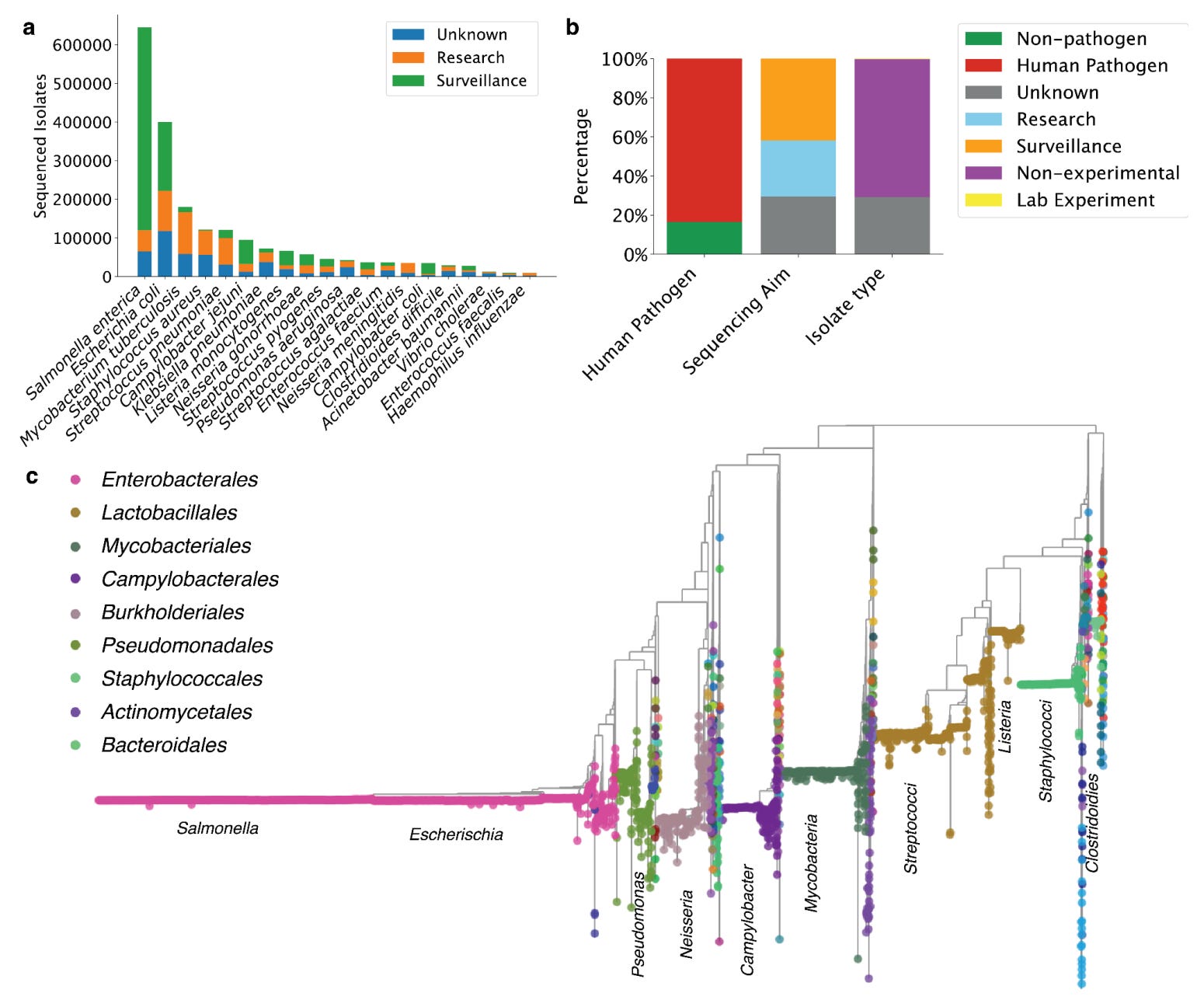
Human genetics has gnomAD: hundreds of thousands of genomes, uniformly processed, searchable, freely available. Microbiology has not had an equivalent. The raw sequencing data is there in INSDC archives but it is inconsistently assembled, inconsistently annotated, and largely inaccessible unless your group can build and maintain its own processing pipeline. AllTheBacteria does for bacteria what gnomAD did for human genetics. 2.4 million genomes from 11,273 species, all processed the same way, all queryable.
What It Is
Martin Hunt, Marcelo Torres and a large international consortium took all public bacterial and archaeal short-read whole-genome sequencing data from INSDC and ran it through uniform assembly, quality control, and annotation. Every genome gets standardised taxonomy, gene calls, antimicrobial resistance predictions, antiphage-defence annotations, protein structure predictions, and AI-ready sequence tables.
To demonstrate what you can do with this, the team ran their deep learning model APEX 1.1 against AllTheBacteria proteomes and identified 1,867 candidate encrypted antimicrobial peptides. They synthesised 24 of them, tested against 20 clinically relevant pathogens including resistant strains, and found multiple hits with low-micromolar activity. A lead molecule, ATB20, reduced Acinetobacter baumannii burden in a mouse skin abscess model with efficacy comparable to polymyxin B.
Why This Is Cool
This is infrastructure. The antimicrobial peptide discovery is the validation experiment showing what becomes possible when 2.4 million annotated genomes are openly available and searchable. The barrier for training ML models on bacterial sequences, running comparative genomics at scale, or doing real-time resistance surveillance used to be whether your group could maintain its own pipeline. That barrier is now gone. The fact that a relatively straightforward query immediately turned up a validated antibiotic active against a WHO priority pathogen tells you how much untouched biology is sitting in public archives.
Read the paper.
Try the code.
🗓️ Events & Competitions
The best competitions, hackathons, and community challenges in AI x life sciences, curated weekly. Know something worth featuring? Reply and let us know.
More upcoming events:
BioHackathon Europe 2026 | November 9-13, Barcelona
ELIXIR’s annual international bioinformatics hackathon, running since 2018. 160+ participants, five days of collaborative coding on open bioinformatics infrastructure and tools. The call for project proposals has now closed.
Thanks for reading!
💬 Get involved
We’re always looking to grow our community. If you’d like to get involved, contribute ideas or share something you’re building, fill out this form or reach out to me directly.
Connect With Us
Have questions or suggestions? We'd love to hear from you!
📧 Email Us | 📲 Follow on LinkedIn | 🌐 Visit Our Website